Introduction:
Prospice is one of the finest and most inspiring poems by the eminent Victorian poet Robert Browning (1812–1889). First published in 1864 in the collection Dramatis Personae, the poem is widely regarded as Browning’s personal declaration of courage, optimism, and unwavering faith in the face of death. The title Prospice is derived from a Latin word meaning “Look Forward” or “Look Ahead,” which aptly reflects the central message of the poem—facing the future, especially death, with fearless determination rather than fear or despair.
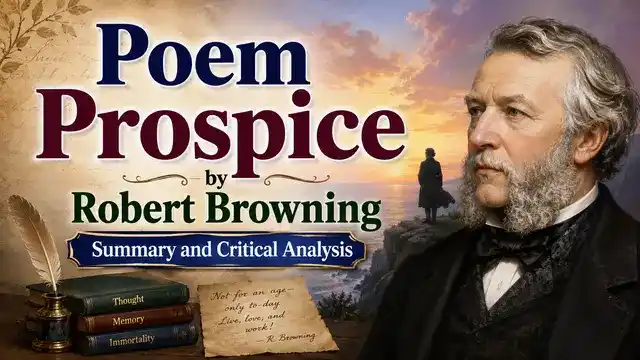
The poem was written after the death of Browning’s beloved wife, Elizabeth Barrett Browning, in 1861. Deeply affected by her loss, Browning transforms his personal grief into a universal meditation on mortality. Instead of lamenting death, he presents it as the final challenge that every human being must bravely confront. For Browning, death is not an end but a gateway to eternal life and joyful reunion with his departed wife. This optimistic vision distinguishes Prospice from many elegiac poems that focus primarily on sorrow and mourning.
In Prospice, Browning rejects the idea of escaping suffering or seeking an easy death. He compares life to a battlefield and death to the last and greatest battle that a courageous person must fight. The speaker welcomes every hardship, pain, and danger because they test human strength and character. He believes that true victory belongs to those who face life’s trials with courage and dignity. Thus, the poem celebrates the ideals of heroism, endurance, perseverance, and moral courage.
The poem is deeply influenced by the Victorian spirit of confidence, self-reliance, and Christian faith. Browning’s belief in the immortality of the soul and the existence of life after death forms the philosophical foundation of the poem. His optimistic outlook transforms death from a terrifying mystery into a triumphant passage leading to eternal happiness. This faith gives the speaker the strength to confront death boldly without hesitation or fear.
Written in dramatic monologue form, Prospice employs vivid natural imagery, powerful metaphors, and energetic rhythms to portray the struggle between life and death. Images of storms, mountains, darkness, and battle symbolize the hardships that precede the final victory. The poem’s vigorous language and emotional intensity reinforce Browning’s message that courage is the highest human virtue and that death should be accepted as a natural and glorious culmination of life.
Overall, Prospice is a profound philosophical and inspirational poem that transforms the fear of death into a celebration of courage, faith, hope, and spiritual triumph. It stands as one of Robert Browning’s greatest achievements, conveying the timeless message that those who confront life’s final challenge with bravery will ultimately attain eternal peace, victory, and reunion with their loved ones.
Stanzawise Summary:
Stanza 1:
Fear death? -to feel the fog in my throat,
The mist in my face
When the snows begin, and the blasts denote
I am nearing the place.
Explanatory Word-Meanings:
Fog in the throat = choking sensation felt in the throat. Mist = dimness of sight. Snows = coldness of death. Blasts = hard breathings at the time of death. Nearing the place = death is about to come.
Paraphrase:
The poet feels that his death is about to come. He feels a choking sensation in the throat. He sees dimness before his eyes. He feels cold all over his body. He has difficulty in breathing. All these symptoms indicate that the poet is nearing death. He, therefore, questions himself if he should fear death.
Stanza 2:
The power of the night, the press of the storm,
The post of the foe;
Where he stands, the Arch fear in a visible form,
Yet the strong man must go;
Explanatory Word-Meanings:
Press = pressure. Post = place. Foe = enemy. Arch = big. Must go = must face
Paraphrase:
When a person nears death, he sees all-pervading darkness of death before him. He feels the pressure of storm of bubbling emotions inside. He sees death standing before his eyes. Death which is the greatest fear of all living creatures stands before him in the visible form. The dying man fears it but a strong man must face it heroically.
Stanza 3:
For journey is done and the summit attained,
And the barriers fall,
Though a battle’s to fight ere the guerdon be gained,
The reward of it all.
Explanatory Word-Meanings:
Journey is done = the journey of life is over. Summit attained = the highest point of the life is reached. Barriers = hurdles. Ere = before. Guerdon = reward. Reward of it all= the best reward of fighting death.
Paraphrase:
The poet visualises that the journey of his life is going to end. He has attained the highest point of life. He has no desire to live. All the obstacles which stood in his way have fallen. Still he has to fight a battle with death in order to obtain the best reward of life. The best reward of his life is his meeting with his wife in heaven.
Stanza 4:
I was ever a fighter, so – one fight more,
The best and the last!
I would hate that death bandaged my eyes, and forbore ,
And bade me creep past
Explanatory Word-Meanings:
Bandaged = blindfolded eyes with fear. Forbore = restrained. Bade me creep past = commanded me to surrender.
Paraphrase:
The poet does not want to die like a coward. He does not want that death should command him the way it likes. He has been a fighter throughout his life. He would like to have one fight more with death, the greatest enemy of man. He would not like death that blindfolded his eyes with fear and commanded him to surrender before it. He would rather fight it with courage and bravery.
Stanza 5:
No! let me taste the whole of it, fare like my peers
The heroes of old,
Bear the brunt, in a minute pay glad life’s arrears,
Of pain, darkness and cold.
Explanatory Word-Meanings:
Fare like my equals = suffer like my equals. Bear the brunt =endure utmost pain and suffering. Life’s arrears = remaining pains of life.
Paraphrase:
The poet regards death as a gateway to new life. He wants to experiences the whole of his life with all its sufferings and pains. He wants to experience death like his equals of the past who fought death and made themselves immortal. He wishes to endure utmost sufferings and pains remained untasted so far. He is glad in experiencing pain, darkness and cold resulting from death.
Stanza 6:
For sudden the worst turns the best to the brave,
The black minute’s at end,
And the element’s rage, the fiend-voices that rave,
Shall dwindle, shall blend,
Shall change, shall become first a peace, out of pain
Then a light, then thy breast,
O thou soul of my soul! I shall clasp thee again.
And with God be the rest!
Explanatory Word-Meanings:
The black minute = the critical moment of death. The element’s rage = fury of Nature. Fiend voices =devilish sounds. Rave = talk wildly. Dwindle = reduce. Blend = lose their existence. Clasp = embrace.
Paraphrase:
If a man is prepared to fight death without any fear, he is rewarded with peace and joy in the next life. To a dauntless fighter, the best reward of life comes after his death. When the critical moment of death is over, the fury of Nature, and the devilish voices which a dying man hears subside and lose their existence. All of a sudden, the old life passes giving place to a new one. The new life brings with it serenity, cheerfulness and joy unknown in the mortal world. He sees the divine light of heaven. He sees his wife too. The two loving souls meet in heaven and enjoy the blessings of God.
Critical Appreciation of Poem:
Background:
This is an optimistic poem of Robert Browning. It is a dramatic monologue expressing the poet’s courage, hope and determination. It was composed after the death of Mrs. Browning and was first published in 1864 in Dramatic Personae.
Thought – content:
The title of the poem which is of Latin origin itself suggests the thought – content of the poem. It means to look forward. The poet looks forward to meet his dear departed wife in heaven. He thinks that death is a gateway to heaven where his beloved awaits him. He is, therefore, determined to fight death with all its coldness, darkness and pains. He would demolish all the barriers that stand between him and his departed wife. His heroic death will be the best reward of his life because it will bring to him not only heavenly serenity and delight but also celestial love. It will enable him to re unite with his wife.
Form:
This is a dramatic lyric in the form of a monologue. This is a speech of a dying man addressed to himself. The poem has in all seven stanzas. But the last two stanzas are not clearly demarcated. The idea of the sixth stanza runs into the seventh stanza of the poem. The first and third lines of each stanza are long whereas the second and fourth lines are short.
Diction:
The words and phrases culled and coined by the poet are quite appropriate for the purpose . The poet draws a graphic picture of a dying man in the following words:
“Fear death? -to feel the fog in my throat,
The mist in my face
When the snows begin, and the blasts denote
I am nearing the place. “
A note of optimism:
The poem strikes a note of optimism of the poet. He is not afraid of death because it opens the gates of heaven. He is, therefore, determined to fight a battle with death in order to enjoy celestial peace, joy and love. He writes ahead:
“I was ever a fighter, so – one fight more,
The best and the last!
I would hate that death bandaged my eyes, and forbore,
And bade me creep past. “