Introduction:
Robert Browning’s Porphyria’s Lover is one of the finest examples of a lyrical monologue, also known as an interior monologue, in English literature. Unlike a traditional lyric poem that expresses the emotions of the poet, this poem presents the innermost thoughts, emotions, and psychological conflicts of a fictional speaker. Browning allows the speaker to narrate his own experience in a deeply personal and emotional manner, revealing his disturbed state of mind without any direct intervention from the poet. The entire poem unfolds through the speaker’s voice, making readers witnesses to his shifting emotions, irrational reasoning, and horrifying actions. The poem combines the emotional intensity of lyric poetry with the dramatic qualities of a monologue, creating a powerful psychological portrait of a man obsessed with possessing his beloved forever.
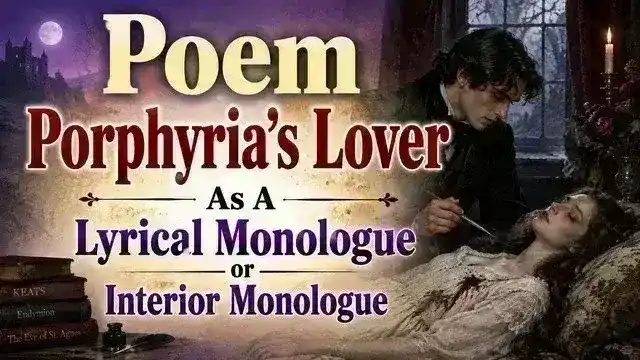
As an interior monologue, Porphyria’s Lover records the speaker’s private thoughts as they flow naturally after he has murdered Porphyria. There is no dialogue or external narration; instead, readers enter directly into the speaker’s consciousness. His narration moves freely between observation, memory, emotion, and justification, exposing his increasingly unstable mind. Browning masterfully reveals the speaker’s madness not by describing it objectively but by allowing the speaker to condemn himself through his own words. The silent listener remains absent, and the poem becomes a dramatic exploration of guilt, obsession, love, jealousy, and psychological disturbance.
The poem is also highly lyrical because of its musical rhythm, emotional depth, vivid imagery, and intimate tone. It beautifully depicts the stormy evening, Porphyria’s tenderness, and the speaker’s overwhelming emotions before suddenly shifting into a scene of shocking violence. The contrast between romantic love and brutal murder intensifies the emotional impact of the poem. The lyrical beauty of the language makes the psychological horror even more striking, demonstrating Browning’s remarkable ability to blend poetic elegance with dramatic realism.
Furthermore, Browning uses the lyrical monologue to explore important Victorian concerns about morality, power, love, and mental illness. The speaker’s attempt to preserve a perfect moment of love by murdering Porphyria reflects his distorted understanding of beauty, possession, and eternity. His calm justification of the crime and his belief that God has not punished him reveal the dangerous consequences of obsessive love and psychological instability. Readers are left to judge the speaker’s actions while recognising the tragic complexity of his emotions.
Thus, Porphyria’s Lover stands as a brilliant example of a lyrical monologue or interior monologue, where the poet fuses lyricism with dramatic self-revelation. Through a single speaker’s uninterrupted confession, Browning exposes the darkest corners of the human mind and transforms a private psychological experience into a timeless work of dramatic poetry. The poem remains one of the greatest studies of obsession, madness, and the complexities of human consciousness in English literature.
Porphyria’s Lover as a Dramatic Monologue:
Porphyria’s Lover is a dramatic monologue, a poem in which a speaker talks to a silent listener about a dramatic event or experience. Browning is considered to be one of the earliest and greatest practitioners of this form, and Porphyria’s Lover is his first poem in this style. The dramatic monologue offers readers intimate insight into the speaker’s changing thoughts and feelings because he presents in his own words how he sees and understands the situation he discusses. However, as becomes clear in Porphyria’s Lover, much of what the reader learns about the speaker of the monologue comes not from the speaker’s own revelations but from what he does not say. The speaker in Porphyria’s Lover, for example, never declares that he is mad, but the reader infers from his words that he must be.
Porphyria’s Lover as a Lyrical or Interior Monologue:
Though the poem is described as an early experiment in dramatic monologue, it will be better to call it a lyrical monologue, or interior monologue as in a stream of consciousness novel. Here the speaker is only thinking aloud; he is not trying to carry conviction to another person in the scene, as is usual in a typical dramatic monologue. This poem is therefore more in the nature of a lyrical monologue or interior monologue, which may not be addressed to any other character who may be there close to the speaker. Porphyria’s Lover is a dramatic lyric of a pale lover, who is loved by Porphyria.
The Story of Porphyria and Her Lover:
She could not marry him because of the false family pride and social distinctions and barriers. One night when it was raining heavily and the fierce wind was blowing, she left the feasting at her castle and visited her lover. The lover’s heart swelled with pride and joy when she made him believe of her sincerity in love. In order to immortalize that moment of happiness, he strangled her with the tresses of her long golden hair. He kissed her rosy cheeks and raised her head but as it was lifeless, it rested on his shoulder. He and his beloved remained seated in the same position throughout the night.
Tragedy and Satire on Social Conventions:
The death of Porphyria is tragic, but it also constitutes a satire against social conventions and barriers which stand in the way of sincere lovers. Porphyria was very happy even in her death because the family pride and social barriers could no more stand in the fulfilment of her greatest wish:
“Her head, which droops up on it still
The smiling rosy little head,
So glad it has its utmost will,
That all it scored at once is fled.”
H.C. Duffin’s Interpretation of the Poem:
H.C. Duffin writes, “Porphyria’s Lover” is as beautiful as its title. Having been published first as one of the two “Madhouse Cells”, it is generally regarded as an essay in the macabre, the words “and strangled her”, so strikingly placed, being read literally. It would evidently make the picture more pleasing if we could take them to mean “pretended to strangle her”, and since the rest of the poem favours this reading I do not see why we should not get pleasure instead of horror out of the poem. Browning is apt to be realistic in his details, and the sentence, “again laughed the blue eyes without a stain”, does not sound like an exact description of a girl’s appearance after she has been strangled, nor would her cheek blush bright under a kiss:
“And all night long we have not stirred,
And yet God has not said a word.”