Introduction:
Robert Lynd (1879–1949) occupies a distinguished place in the history of twentieth-century English literature as one of the finest and most accomplished familiar essayists. Celebrated for his graceful prose, gentle humour, keen observation, and profound understanding of human nature, Lynd transformed the ordinary experiences of everyday life into engaging and thought-provoking literary essays. His writings combine wit, imagination, wisdom, and simplicity, making him one of the most widely admired essayists of the modern age. Through his unique ability to discover beauty and significance in commonplace events, Lynd elevated the familiar essay into an art form that continues to attract readers across generations.
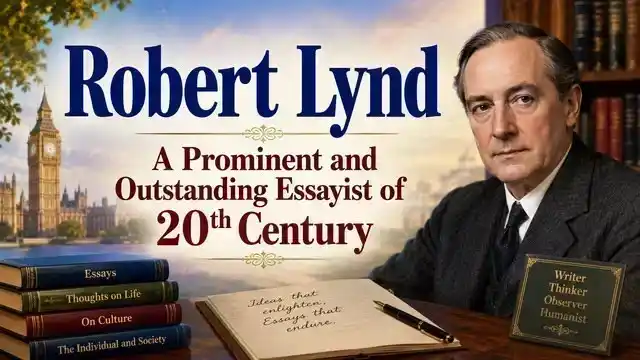
Born in Belfast, Ireland, Robert Lynd received his education at the Royal Belfast Academical Institution and later at the University of Belfast. Although he initially considered a career in religion, his passion for literature, journalism, and public affairs led him to writing. He became a successful journalist and literary critic, contributing regularly to leading newspapers and magazines. His long association with The New Statesman established him as an influential literary voice whose essays reflected intellectual depth, refined taste, and a compassionate outlook on life.
Robert Lynd’s essays are admired for their conversational tone, lyrical style, and philosophical insight. Unlike formal or argumentative essayists, he wrote in a friendly and intimate manner, as though engaging in a pleasant conversation with his readers. His subjects are drawn from ordinary life—books, dreams, walking, holidays, weather, childhood memories, habits, pets, gardens, and countless everyday experiences. Through these familiar topics, he reveals universal truths about human behaviour, emotions, and society. His essays never preach or moralize; instead, they gently encourage readers to reflect on life with curiosity, humour, and understanding.
One of the most remarkable qualities of Lynd’s writing is his extraordinary power of observation. He notices details that often escape ordinary attention and presents them with freshness, originality, and poetic charm. His delicate humour, free from bitterness or sarcasm, creates an atmosphere of warmth and intimacy. At the same time, his essays display intellectual maturity and subtle philosophical reflection, proving that even the simplest incidents of daily life can possess profound meaning.
Robert Lynd was deeply influenced by the great English essay tradition established by Charles Lamb, Joseph Addison, and Richard Steele. However, he developed a distinctive style of his own by blending literary elegance with modern sensibility. His essays are characterized by clarity, refinement, imaginative expression, and an enduring human appeal. Collections such as The Blue Lion and Other Essays, The Pleasures of Ignorance, The Peal of Bells, The Goldfish, and Solomon in All His Glory remain enduring examples of his literary craftsmanship.
As a familiar essayist, Robert Lynd believed that literature should delight as well as enlighten. His essays celebrate the joys, ironies, and mysteries of ordinary existence while encouraging readers to appreciate the small pleasures of everyday life. His remarkable command of language, balanced judgment, and artistic sensitivity enabled him to combine entertainment with thoughtful reflection, making his works intellectually enriching as well as aesthetically satisfying.
Today, Robert Lynd is remembered as one of the greatest essayists of the twentieth century. His timeless essays continue to be studied for their literary elegance, humanistic vision, humour, and philosophical depth. By transforming commonplace experiences into memorable works of art, Robert Lynd secured a permanent place among the masters of the English familiar essay and remains an enduring inspiration for students, scholars, and lovers of English literature worldwide.
Real Essayist and an Eminent Writer:
Robert Lynd was one of the most outstanding essayists of the 20th century. He began his career as a journalist and for nearly twenty years under the name of ‘YY’ appeared his weekly essay in The New Statesman and Nation. Like Chesterton, he had the Fleet Street for his background, and though he was out and out à journalist, his prose is not vitiated by the defects of journalism.
His sentences are flawless, his diction is chaste and show by a fine taste and even his subject is not of temporary interest. Indeed, he is worth reading for his urbanity, wit and humour, engaging style and his passive philosophy of life which we can gather from his weekly commentary upon passing events for nearly twenty years. J. B. Priestley observes: “He has marched into literature by way of journalism, the days’ round, the common task. It is not everybody’s way, it is especially suitable for writers with well stored, sane and masculine minds, men who can take hold of experience and translate it freely, who can ransack their own minds and blunder outside world with an equal measure of success; and when once a man does enter literature by this road, there can be no doubt as to his capacity; he is worth hearing.”
His Sincerity and No Conflict in His Personality:
His essays are personal in characters and reveal his likes and dislikes on a variety of subjects. They are marked with a note of sincerity. A. S. Collins remarks: “Those who knew him, have testified to the natural sincerity and sterling worth of the man, and his essays are the man.” He knew himself well and there was no conflict in his personality. A. S. Collins says, “He wrote with a detachment that gives a timeless wisdom to his commentary on life. Unlike so many of his contemporaries, he did not want to change the world, but only to encourage it to live, sanely, decently and happily.” He wrote about his memoirs and experiences, but his essays are not disfigured by egotism. He writes with modesty and as though he has infinite leisure.
His Essays, Mirror of His Personality:
Robert Lynd’s essays are the mirror of the varied features of his personality, as most of them are autobiographical through and through. He is one of those essayists who never feel the pavicity of themes for their essays. He can write on any topic, in his characteristic humorous manner, yet his style never becomes artificial or broken into fragments. His expressions are more often than not humorous and whimsical yet he is amusingly philosophical and meditative or reflective. The essayist attaches his personal emotions to it.
Being a Timeless Essayist:
It is characteristic of Robert Lynd to be timeless. He has the same broad and enduring appeal which he enjoyed in his life time. The charm of his essays lies in the twinkling humour which is not away from irony. Though he was humane and tolerant yet he had an ironic whip for cant and humbug, bunkum and brutality, malice and intolerance. His reflections on flotsam and jetsam of life are sometimes grave, though often they are marked with gaiety and gusto.
Attaching His Personal Emotions as Themes:
Robert Lynd chooses any theme and attaches his personal emotions to it and makes it debatable and analytical which come to have, therefore, a universal appeal. The reader while reading his essays at once establishes identity of his feelings with them or regards himself as sharing characteristics with them and also enjoys the same joy that the essayist himself enjoyed while writing the essay.
His Convincing Observations on Poetry and Poets:
Robert Lynd is a writer of fine critical prose, and his essays on Modern Poetry exhibit his insight into modern poetry and poetic trends. His observations on poets also seem to be convincing because he has a way of saying that is very convincing. His estimate of Walter De la Mare is a specimen of sound judgement and charming style. Of all contemporary poets, there is none who is so obviously the poet of home sickness as Mr. De la Mare. He is the poet of love shackled with vain longing for lovely things that pass, for love that passes. He draws consolation, however, from the fact that, though things pass, they pass in perpetuity of beauty.
A Stable Critic of Morals and Art:
Richard observes: “Examine his essays and you will see how he builds up an argument by a skilful illustration of exceptions; how he reabsorbs those exceptions and closes down with a neat, swift stroke that shows no temporizing hand.” With all his tolerance, Lynd is implacable in his detestation of bunken and brutality. His taste is unerring. As a critic of morals and art he is stable because he knows his own instincts and their foundations in a tradition which he can defend fully and consciously. Sanity, a deep penetrating humour born from a love of his fellowmen, a quick appreciation of nature, these are faculties of an essayist who perhaps pleases himself in being deceptive. His depth, like that of clear pool into which the sun is shining, is greater than it seems. Such is Robert Lynd’s still eluding the critic.
Prose Style:
Lynd shows great charm and beauty in language and style. His style is simpler and less elaborate. His observation on men and manners shows a strange lightness of touch and insight. Even in the most trivial of his efforts he seldom fails to delight or to instruct. He makes his essays the occasion for trenchment criticism of life. We find also a philosophical skill in Robert Lynd. In his hands, an insignificant, meaningless fact or idea magnifies and philosophical colouring by skilfully relating it to universal Truth or something akin to it. The literary allusions come to him naturally and spontaneously. These are never forcibly produced or deliberately intrude. He has also employed a number of anecdotes in his essays that add charm and enchantment to them. For instance, in his essay entitled The Pleasures of Ignorance, he writes: “A contemporary English novelist was once asked by a foreigner what was the most important crop in England. He answered without a moment hesitation: ‘Rye’. Ignorance so complete as this seems to me to be touched with magnificance; but the ignorance even of illerate persons is enormous.” Robert Lynd’s essays sometimes reveal the skilful use of figurative language. His style is thoroughly conversational, pleasing and not unmixed with humour and irony. His love of epigrammatic sentences, his clarity and lucidity, his sense of balance, the use of similes, the phrase – making gift are the outstanding qualities of his prose style.