Introduction:
William Wordsworth (1770–1850), one of the greatest poets of the Romantic Age, is celebrated as the supreme poet of nature and spiritual experience. Among his finest works, Lines Composed a Few Miles above Tintern Abbey (1798), commonly known as Tintern Abbey, occupies a distinguished place in English literature. Published in the landmark collection Lyrical Ballads, the poem marks a significant development in Wordsworth’s poetic philosophy and presents his mature vision of nature, humanity, memory, and the divine. More than a simple description of a beautiful landscape, Tintern Abbey is a profound spiritual meditation in which the poet reveals his mystical relationship with nature. It illustrates how the external world transcends its physical beauty to become a source of moral guidance, inner peace, and spiritual enlightenment.
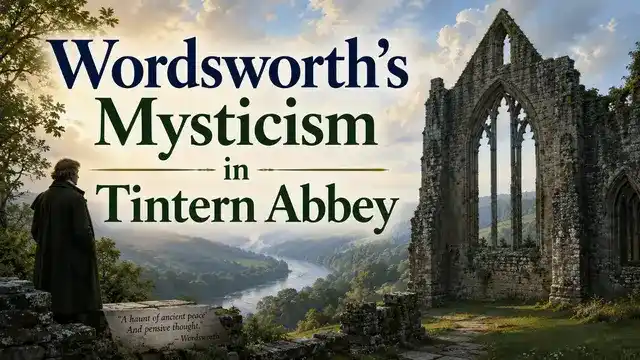
Wordsworth’s mysticism is unique because it is rooted not in religious dogma or supernatural visions but in direct communion with nature. He believes that nature is the visible manifestation of an invisible spiritual power that pervades the entire universe. Throughout Tintern Abbey, the poet expresses his conviction that every natural object is animated by a divine presence and that human beings can attain spiritual insight through contemplation of the natural world. This mystical perception enables him to discover unity between the individual soul, nature, and the Supreme Spirit, thereby transforming ordinary experiences into moments of profound revelation.
A central aspect of Wordsworth’s mysticism in Tintern Abbey is the concept of the “sense sublime.” The poet experiences an all-pervading spiritual force that dwells in the light of the setting sun, the rolling ocean, the living air, the blue sky, and the mind of man. This universal spirit binds together all forms of existence, making nature a sacred temple where the human soul finds harmony with the infinite. Thus, the poem reflects a philosophy that closely resembles pantheism, as God is perceived not as separate from nature but as immanent within it.
Another important mystical element in the poem is the transformative power of memory. During his five years away from the banks of the River Wye, Wordsworth preserved the impressions of nature in his mind. These recollections became a source of spiritual comfort, emotional healing, and moral strength amid the anxieties of daily life. Memory allows the poet to relive his mystical experiences and reinforces his belief that nature continues to nourish the soul even in physical absence. Consequently, nature becomes both an external reality and an inward spiritual presence.
The poem also traces the evolution of Wordsworth’s mystical consciousness. In his youth, he delighted in nature for its physical beauty and sensory excitement. As he matured, however, his appreciation deepened into a spiritual understanding. He no longer sought mere pleasure in natural scenery but recognized nature as a moral teacher, a guide, a guardian, and the dwelling place of the Divine. This transition from sensory enjoyment to spiritual realization forms the essence of Wordsworth’s mysticism and distinguishes Tintern Abbey as one of the greatest expressions of Romantic spirituality.
Furthermore, Wordsworth extends this mystical vision to humanity through his affectionate address to his sister Dorothy. He hopes that she too will experience the same spiritual communion with nature and derive from it comfort, wisdom, and moral strength. This faith in nature’s universal power to elevate the human soul demonstrates the poet’s belief that mystical experience is not confined to exceptional individuals but is accessible to all who approach nature with purity, sensitivity, and reverence.
In conclusion, Tintern Abbey is a timeless masterpiece that embodies the highest expression of Wordsworth’s mystical philosophy. It presents nature as a living, divine presence that inspires the human soul, reveals the unity of all existence, and leads to spiritual fulfillment. Through its profound reflections on nature, memory, imagination, and the divine, the poem transforms ordinary landscape into a sacred experience, establishing Wordsworth as one of the greatest mystical poets in English literature. His mysticism, founded on personal experience and intimate communion with nature, continues to inspire readers with its message of harmony, spiritual awakening, and the eternal presence of the Divine in the natural world.
Wordsworth, A Seer and Mystic:
Wordsworth is unanimously acknowledged as a mystic. Mysticism involves the perception of a divine unity behind the ordinary physical world. The mystic sees a divine unifying life in all lives and considers all things in the visible world as manifestations of the one divine life. In the words of Spurgeon, “Wordsworth was not only a poet, he was also a seer and a mystic and a practical psychologist with an amazingly subtle mind and an unusual capacity for feeling. It was not the beauty of Nature which brought him joy and peace, but the life in Nature . He himself had caught a vision of that life . He knew it and felt it, and it transformed the whole of the existence for him.”
Nature’s Having Life and Joy for Wordsworth:
For Wordsworth, Nature has life and joy in herself; she is manifestation of an “active principle” which has its noblest seat in the mind of man. His senses, through which he communicates with Nature, feed his soul, being the chief inlets of soul in this age. That is why Wordsworth can say without hyperbole that Nature is the guardian of his heart and soul of all his moral being.
Wordsworth’s Awareness of God:
Wordsworth’s whole being is an awareness of God, a union or communion in which all thought expires in blessedness and love. In Tintern Abbey Wordsworth calls this state of the soul as the state of the “blessed wood”,
“In which the burthen of the mystery,
In which the heavy and the weary weight
Of all this unintelligible world,
If lightened! -that serene and blessed mood,
In which the affections gently lead us on,—
Until, the breath of this corporeal frame
And even the motion of our human blood
Almost suspended, we are laid asleep
In body, and become a living soul:
While with an eye made quiet by the power
Of harmony, and the deep power of joy,
We see into the life of things.”
To Wordsworth God in Man and in Nature Is One:
It is in this “blessed mood” the poet holds communion with Nature. In this regard S.A. Brooke’s words are quote worthy: “Between the spirit in Nature and the mind of Men there is a prearranged harmony, and it is this harmony which enables Nature to communicate its own thoughts to men and to effect upon them until a union between them is established.” In this communion, which is very much like an Indian sage’s Samadhi, the poet derives beatitude attitude or Anand. He feels a presence which is common to man and Nature. To Wordsworth God in Man and in Nature is one. This idea is expressed in the following lines of Tintern Abbey.
“I have felt
A presence that disturbs me with the joy
Of elevated thoughts: a sense sublime
Of something for more deeply interfused,
Whose dwelling is the light of setting suns,
And the round ocean, and the living air,
And the blue sky, and in the mind of man;
A motion and a spirit, that impels
All thinking things, all objects of all thought
And rolls through all things—”