Introduction:
The Shakespearean Sonnet, also known as the English Sonnet, is one of the most celebrated poetic forms in English literature. Although it was inspired by the earlier Italian (Petrarchan) Sonnet, it developed into a distinct form that reflects the structure, rhythm, and expressive possibilities of the English language. While the Italian sonnet was perfected by the fourteenth-century Italian poet Petrarch, the Shakespearean sonnet reached its highest level of artistic excellence in the hands of William Shakespeare, whose collection of 154 sonnets established the form as a masterpiece of English poetry.
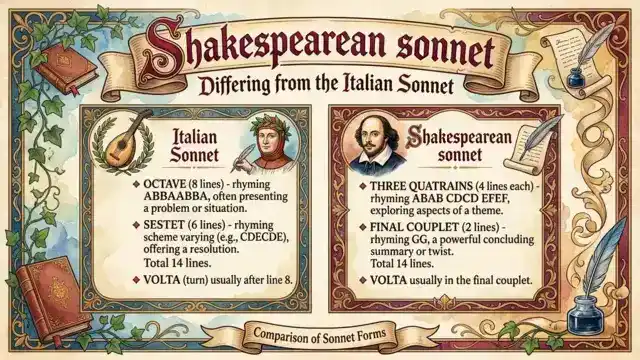
The most significant difference between the two forms lies in their structure, rhyme scheme, and method of developing ideas. The Italian sonnet is divided into an octave (eight lines) followed by a sestet (six lines), generally following the rhyme scheme ABBAABBA CDECDE (or a similar variation). The octave introduces a problem, emotion, or argument, while the sestet provides a response, solution, or reflection. In contrast, the Shakespearean sonnet consists of three quatrains (four-line stanzas) followed by a rhyming couplet, with the rhyme scheme ABAB CDCD EFEF GG. Each quatrain develops a different aspect of the central idea, and the concluding couplet delivers a striking summary, resolution, epigram, or unexpected twist.
Another important distinction is the placement of the volta, or the “turn” in thought. In the Italian sonnet, the volta usually appears at the beginning of the ninth line, marking a clear shift in mood or argument. In the Shakespearean sonnet, however, the turn is often more flexible, occurring around the ninth line or being reserved for the final rhyming couplet, where the poem reaches its climax through a memorable conclusion.
The Shakespearean sonnet also differs in its style and thematic treatment. While Petrarchan sonnets primarily idealize unattainable love and the beauty of the beloved, Shakespeare expanded the scope of the sonnet to include themes such as love, friendship, beauty, time, mortality, betrayal, jealousy, aging, poetry, and the permanence of art. His sonnets combine emotional depth with intellectual insight, making them universal reflections on the human condition rather than merely expressions of romantic devotion.
Furthermore, the Shakespearean sonnet is written in iambic pentameter, a rhythmic pattern that closely resembles the natural flow of English speech. The alternating rhyme scheme and the concluding couplet provide greater flexibility and dramatic impact, making the form particularly suited to the English language. Shakespeare’s skillful use of imagery, metaphor, paradox, irony, and wordplay enriches the poetic texture and enhances the emotional and philosophical power of his sonnets.
In conclusion, although the Shakespearean sonnet owes its origin to the Italian sonnet, it represents a unique and independent evolution of the form. By replacing the octave-sestet division with three quatrains and a concluding couplet, adopting a new rhyme scheme, and broadening the thematic range, Shakespeare transformed the sonnet into a versatile medium capable of expressing profound emotions and universal truths. As a result, the Shakespearean sonnet remains one of the finest achievements in English poetry and continues to inspire readers and poets across the world.
What is Sonnet:
The word sonnet has been derived from the Italian Sonnetto meaning a little strain. Originally it was a poem to be sung or recited to music, but now it stands for a written lyric of fixed form, expressing a single idea (one main idea) or emotion consisting of fourteen decasyllabic. The rhyme, in English usually follows one of the two main patterns. The Italian or Petrarchan sonnet falls into two main parts: an Octave (8 lines) rhyming abbaabba and a Sestet (6 lines) rhyming cdecde or some variant, such as cdccdc. Shakespearean sonnet falls into three quatrains and a concluding couplet. Its rhyming scheme is ababcdedefefgg.
Its Origin:
Its birth place is not yet definitely determined, but there is little doubt that the form existed in Italy in the later half of the 13th century. It is chiefly associated with the famous Italian poet Petrarch, but it has been earlier used by Dante. Dante wrote sonnets in praise of his beloved Beatrice. Petrarch addressed his sonnets to a lady named Laura. The identity of Laura remains in some doubt but she was certainly a real woman, whom Petrarch loved and adored. Petrarch was a priest, and Laura was probably married, so that their union was almost impossible. He, therefore, sang unrequited love and of his unsatisfied passion and of the restlessness of earthly desire in sonnets that he wrote during her life. Petrarch’s influence on the poets who handled this poetic form later was greater than that of Dante.
The Italian or Petrarchan Sonnet:
The Italian sonnet is composed of—two parts-the Octave, a stanza of eight lines and the Sestet, a stanza of six lines. The Octave has two rhymes arranged according to the following scheme; abba, abba. The sestet has sometimes two rhymes, sometimes three, different from the rhymes of the Octave cde, cde, cdc, ded, cde, dce. The Octave may be divided into two quatrains, the sestet and two tercets. At the end of the Octave, i.e., after the eighth lines, there is a conspicuous pause or Caesura (it is often indicated by a space) followed by a Volta or a turn in the thought.
Shakespearean or English Sonnet:
Sonnet appeared and flowered in the sixteenth century. It was introduced into England by Sir Thomas Wyatt and Henry Howard, Earl of Surrey. They were poet-politicians. Sir Thomas Wyatt went to Italy on some diplomatic mission. In Italy, he saw the new poetic form and brought it to England. He wrote thirty-one sonnets, the first in English. The sonnets of Surrey were grounded in love and were written to Geraldine or Lady Elizabeth Fitzgerald. After the Earl of Surrey a number of Elizabethan poets tried their hands at sonnet writing. The Elizabethan sonnet writers yielded a rich harvest which was a strange medley of splendour and dullness. The workers in this field included Sidney, Spenser and Shakespeare, who in varying degrees invested this poetic form with unquestionable beauty. Shakespeare was the King among the Elizabethan sonneteers. He wrote one hundred and fifty four sonnets. He dedicated 126 sonnets to a handsome young man known as Mr. W. H. and the remaining 28 sonnets were addressed to an ugly and married woman known as the Dark Lady.
Theme of Shakespeare’s Sonnets:
Shakespeare’s sonnets are written around the theme of death and lasting fame, the poet’s own art, friendship, mutability and love. It appears from the reading of the sonnets that Shakespeare was snared by a married woman, the reverse of beautiful according to the conventional Elizabethan standard—dark-haired, dark-eyes and pale cheeked. She was a musician, skilled in touching the virginal—one of three forms of the harpsichord. She was temperamental; she could attract and repel, irritate and soothe the poet. She was a woman faithless to her vow of wedlock. She turned her attention and affection from the poet to the fair youth. Shakespeare limited the theme of his sonnets to love. A critic scholar has discovered in his sonnets the application of the Platonic and Italian themes of three kinds of love—the sexual, the intellectual and the universal. His best sonnets exhibit different aspect of love on the one hand and the lover’s strong emotions for his beloved on the other. In True Love, he requests his beloved not to change her attitude for:
“Love is not love
Which alters when it alteration finds.”
Personal Elements:
The view that his sonnets are autobiographical is based largely on the famous dedication prefixed to the folio of 1609 under the signatures of Thomas Thorpe. Shakespearean critics have arrived at the conclusion that the dedication must have been composed by the poet himself though it appeared under the name of the publisher. Much controversy has been raised over the issue of identification of Mr. W. H. and the Dark Lady. Most critics and biographers of Shakespeare agree that Mr. W. H. means William Herbert and the dark lady of the sonnets was Mary Fitton. The sonnets of Shakespeare tell a story which is personal to the poet and is related with one of his love-affairs. In sonnet No. 144, Shakespeare himself has given the gist of this unhappy love episode.
Technical Structure of Sonnets:
Technically, the Shakespearean sonnet which is the really English form of sonnet is simpler in structural form than the Petrarchan sonnet. This form of sonnet was, no doubt, written before Shakespeare, but it is known after his name because he perfected it. Every sonnet is written in the same pattern. There are three quatrains of four lines each supported by one couplet of two rhyming lines. Thus, the rhyming scheme of Shakespeare’s sonnet is abab, cdcd, efef, gg. Since it is divided into four parts, it has no pause and turn of thought at the end of eighth line.
Poetical Qualities:
Shakespeare’s sonnets are filled with great ideas. In his sonnet No. 116 entitled True Love, he has firm belief that true love has power to show the right path to the confused people who have wandered from their duty. He says that true love remains alive up to the Day of Judgment:
“Love alters not with his brief hours and weeks
But bears it out even to the edge of doom.”
His sonnets are full of grand imagination. In his sonnet No. 116, he imagines that love is like an ever fixed mark. He imagines that Time destroys everything with his bending sickle. He shows his genius in pictorial art. He uses figure of speeches such as personification and metaphor. In sonnet No. 116, he personifies love and time. He uses metaphor in “it is an ever-fixed mark” and “it is the star”. He also uses paradox.