Introduction of the Poem:
“The Striders” is one of the finest nature poems by the renowned Indian poet, scholar, and translator A. K. Ramanujan. The poem presents a vivid picture of water striders—tiny insects that glide effortlessly across the surface of water—and uses their graceful movement to explore deeper philosophical ideas about life, balance, and harmony with nature. Through rich visual imagery, precise observation, and symbolic language, Ramanujan transforms an ordinary natural scene into a profound meditation on the delicate relationship between the physical and the spiritual worlds. The poem reflects the poet’s characteristic style of blending scientific observation with poetic imagination, encouraging readers to appreciate the hidden beauty, mystery, and interconnectedness of the natural world.
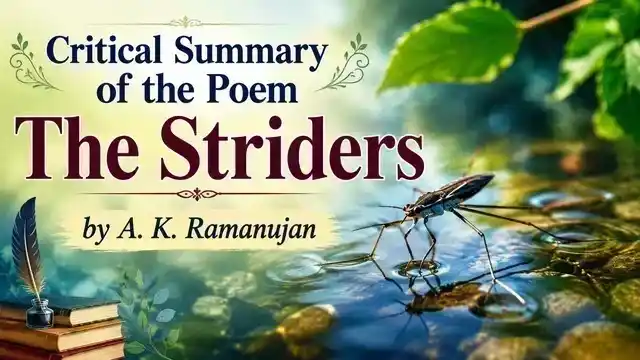
The Striders, taken from Ramanujan’s first volume of poetry The Striders (1966), is a short poem of fifteen lines. Most of the lines consist of just one or two words in this poem.
Critical Summary:
Introduction:
“The Striders” is a short yet profoundly symbolic poem by A. K. Ramanujan. Through the simple image of tiny water bugs gliding effortlessly across the surface of a stream, the poet explores the mysteries of nature, perception, and spiritual insight. The poem demonstrates Ramanujan’s remarkable ability to transform an ordinary natural scene into a philosophical reflection. The poet invites readers to abandon unrealistic dreams and instead observe the extraordinary beauty hidden within the everyday world.
Symbolism of the Water Striders:
The central image of the poem is the water strider, a tiny insect capable of standing and moving on the surface of water. At first glance, the insect appears insignificant, but Ramanujan elevates it into a symbol of balance, grace, and harmony with nature. The bug’s “thin-stemmed” legs and “bubble-eyed” appearance emphasize its delicate structure, while its effortless movement across the stream highlights nature’s subtle miracles. The water strider becomes a symbol of resilience, precision, and the hidden wonders that often escape human attention.
Nature as a Source of Wisdom:
Ramanujan encourages readers to shift their attention from imaginary dreams to the realities of nature. The opening lines, “Put away, put away this dream,” suggest abandoning illusions in favour of direct observation. The poet implies that true knowledge is not found in fantasies but in the careful study of the natural world. Every detail of nature possesses its own mystery, and even the smallest creature can reveal profound truths about existence.
The Metaphor of Walking on Water:
One of the poem’s most striking images appears in the lines, “No, not only prophets walk on water.” Traditionally, walking on water has been regarded as a miraculous act associated with divine figures. Ramanujan challenges this belief by showing that the tiny water bug also performs what appears to be a miracle. This comparison narrows the gap between the sacred and the ordinary, suggesting that miracles exist throughout nature. The poet thus democratizes the idea of wonder, reminding readers that extraordinary experiences are available to anyone who observes carefully.
Imagery and Visual Beauty:
The poem is rich in vivid visual imagery. Expressions such as “dry capillary legs,” “ripple skin,” “landslide of lights,” and “tiny strip of sky” create a beautiful picture of sunlight dancing upon moving water. The stream’s surface becomes a living canvas where light, reflection, and motion blend together. The image of the insect “drowns eyedeep into its tiny strip of sky” is especially powerful, suggesting that the bug sees the reflected sky in the water while remaining perfectly balanced above it. This imagery reveals the interconnectedness of earth, water, light, and sky.
Philosophical Significance:
Beyond its natural description, the poem carries deep philosophical meaning. Ramanujan suggests that reality is often more fascinating than imagination. Human beings frequently overlook the miracles surrounding them because they search for distant ideals or supernatural experiences. The poem teaches mindfulness, encouraging readers to appreciate the complexity and beauty of the present moment. It also reflects the poet’s belief that wisdom emerges from attentive observation rather than abstract speculation.
Style and Language:
The poem is written in free verse, allowing its ideas to flow naturally without the restrictions of rhyme or regular metre. Ramanujan’s language is concise, precise, and highly economical. Despite its brevity, the poem contains layers of symbolic and philosophical meaning. Scientific expressions such as “capillary legs” coexist with poetic metaphors like “landslide of lights,” illustrating the poet’s ability to unite scientific observation with artistic imagination.
Theme:
The poem explores several interconnected themes, including the wonder of nature, the relationship between reality and imagination, spiritual perception, and the extraordinary qualities hidden within ordinary life. It emphasizes that true insight comes from observing the natural world with patience and openness rather than pursuing unrealistic dreams or distant miracles.
Conclusion:
“The Striders” is a masterfully crafted poem that transforms a tiny water insect into a powerful symbol of natural beauty, spiritual insight, and philosophical reflection. Through vivid imagery, subtle symbolism, and simple yet profound language, A. K. Ramanujan demonstrates that the greatest miracles are often found in the smallest details of everyday life. The poem ultimately encourages readers to replace illusion with observation and to recognize the extraordinary richness of the world that surrounds them.