Introduction:
Sarojini Naidu’s The Gift of India is one of the most moving patriotic poems in Indian English literature, expressing the deep emotions of Mother India during the First World War. Written in 1915, the poem gives voice to India as a loving and self-sacrificing mother who mourns the immense loss of her brave sons sent to fight for the British Empire on distant battlefields. Through the symbolic figure of Mother India, Naidu portrays the country’s boundless generosity, unbearable grief, wounded pride, and unwavering hope for justice and recognition. The poem not only commemorates the courage and sacrifice of Indian soldiers but also condemns the indifference of the British rulers, who failed to acknowledge India’s invaluable contributions adequately.
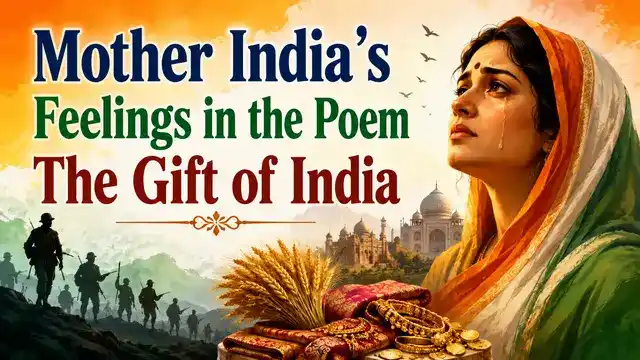
Mother India’s feelings in the poem are rich, profound, and deeply human. She proudly recalls the countless gifts she has offered to the world, including her wealth, natural resources, and, above all, her courageous sons. However, this pride is overshadowed by intense sorrow and maternal anguish as she grieves over the deaths of thousands of Indian soldiers who sacrificed their lives in foreign lands for a cause that was not their own. Her lament is filled with emotional intensity as she imagines the lifeless bodies of her sons lying on the battlefields of France, Flanders, Persia, and Mesopotamia, far away from their homeland and families. The contrast between her pride and her grief creates a powerful emotional appeal that touches the hearts of readers.
At the same time, Mother India expresses silent resentment against the colonial rulers who exploited India’s resources and manpower without giving due honour to her sacrifices. Although she does not openly accuse Britain, her words reveal the pain of a mother whose children’s heroism has been neglected and whose suffering has gone unnoticed. Her emotions reflect not only personal maternal loss but also the collective agony of an enslaved nation yearning for dignity and justice.
Despite her overwhelming sorrow, Mother India remains hopeful and resilient. She believes that the supreme sacrifice of her sons will not be forgotten forever and that one day the world will recognize their courage and honour their memory. Thus, The Gift of India becomes more than an elegy; it is a tribute to patriotism, sacrifice, motherhood, and national pride. Through Mother India’s heartfelt emotions, Sarojini Naidu transforms the poem into a timeless expression of love for the motherland, making it one of the finest patriotic poems in Indian English literature.
Mother India’s Priceless Gifts to the World:
As mentioned in Sarojini Naidu’s poem, the rich gifts that Mother India gave the world are the raiment, grain and gold. This refers to all the resources from agricultural productions to priceless metals which the foreign colonisers took to their country while they were ruling India. She also mentions her soldier sons whom she had sent to foreign lands to fight for others in the world wars.
“Priceless treasures torn from my breast,
And yielded the sons of my stricken womb.”
Mother India’s Grief for Her Martyred Sons:
Mother India is grieved at the death of her soldier sons in the war in foreign countries. She laments the death of Indian soldiers who gave up their lives wholeheartedly to honour their country’s dignity. She speaks about the brutal manner in which the soldiers have died. She expresses her grief for her dead sons through a number of similes following each other in quick succession. Her worthy sons are now buried in their graves in foreign lands like pearls in their shell. Some of them are lying dead in distant Persia, as if they have been sent to sleep by the sweet rhythmic music of her murmuring rivers. There are others whose dead bodies are scattered on the sands of Egypt, as if they were empty shells. Their brave hands have been broken and their faces are deathly pale. There are still others who lie scattered on the blood-stained meadows of France and Flanders. They lie there like flowers that have been plucked and scattered all over by the cruel hands of Destiny.
“Gathered like pearls in their alien graves
Silent they sleep by the Persian waves,
Scattered like shells on Egyptian sands,
They lie with pale brows and brave, broken hands,
They are strewn like blossoms mown down by chance
On the blood – brown meadows of Flanders and France.”
A Mother’s Boundless Love and Sorrow:
She loves her offspring so much as every mother does and that is why she is grieved now at their ill fate. She asks:
“Can ye measure the grief of the tears I weep
Or compass the woe of the watch I keep?
Or the pride that thrills thro’ my hearts’ despair
And the hope that comforts the anguish of prayer!”
Pride and Hope Amidst Despair:
The mother’s sorrows and sufferings are unfathomable. But she is not only sad, but also proud and hopeful for her sons. We cannot measure the pride that thrills through her heart, in spite of her despair. The poet suggests that the speaker, despite her sadness and deep-rooted anguish, is proud of her sons who have fought bravely and brought victory.