Introduction:
Boat-Ride along the Ganga is one of the most celebrated poems by Keki N. Daruwalla and appears as the opening poem in his acclaimed collection Crossing of Rivers. The poem presents a powerful, realistic, and deeply symbolic portrayal of the River Ganga and the ancient city of Varanasi (Banaras), one of the holiest pilgrimage centres in India. Rather than glorifying the sacred river through conventional religious sentiment, Daruwalla offers a penetrating and objective vision of the contradictions that surround it, exposing the coexistence of faith and superstition, holiness and pollution, life and death, spirituality and materialism. The poem is regarded as one of the finest examples of modern Indian English poetry because of its vivid imagery, sharp social criticism, and philosophical depth.
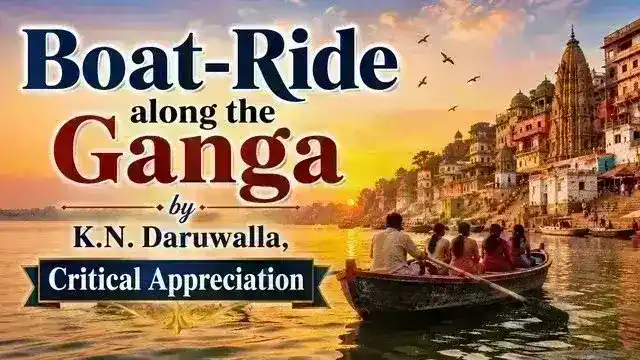
The poem begins with the speaker’s evening boat journey across the Ganga, from where he observes the ghats, temples, funeral pyres, priests, pilgrims, boatmen, and ordinary people who inhabit the riverbanks. As the journey progresses, the poet records the sights with remarkable precision, revealing a landscape that is at once sacred and disturbing. The burning funeral pyres, polluted waters, smoky atmosphere, chanting priests, and bustling crowds create an unforgettable panorama of Banaras, where religious rituals continue amidst decay and environmental degradation. Daruwalla’s keen observation transforms the physical landscape into a symbolic representation of contemporary Indian society.
One of the greatest strengths of the poem lies in its exploration of paradox. The Ganga, traditionally worshipped as the purifier of sins and the divine mother of Indian civilization, is shown carrying filth, ashes, and pollution. The city that promises spiritual liberation simultaneously reveals poverty, exploitation, and human suffering. Funeral fires burn beside cooking fires, and sacred rituals exist alongside commercial interests. These striking contrasts challenge the reader to reconsider the gap between religious ideals and social realities. Instead of condemning religion itself, Daruwalla questions the hypocrisy, neglect, and blind customs that have obscured its true spiritual values.
The poem also reflects Daruwalla’s characteristic poetic style, which combines realism with symbolism. His language is direct yet highly imaginative, enriched with powerful similes, metaphors, visual imagery, and irony. Every image contributes to the poem’s atmosphere of uneasiness and contemplation. The river becomes more than a geographical entity; it emerges as a metaphor for the continuous flow of human existence, where birth, life, death, and rebirth merge into an eternal cycle. Through this symbolic treatment, the poem transcends its immediate setting and speaks about universal human experiences.
Another significant aspect of the poem is its philosophical outlook. The poet neither romanticizes nor rejects the sacred city. Instead, he presents Banaras as a place where opposing realities coexist naturally. The burning ghats constantly remind humanity of the inevitability of death, while the everyday activities of the living affirm the continuity of life. This coexistence of mortality and survival creates the poem’s profound existential vision and invites readers to reflect upon the transient nature of human existence.
Thus, Boat-Ride along the Ganga is much more than a descriptive travel poem. It is a profound meditation on Indian culture, religion, society, and the human condition. Through his realistic observation, symbolic imagination, and critical insight, Keki N. Daruwalla transforms an ordinary boat ride into a compelling exploration of faith, mortality, pollution, and spiritual ambiguity. The poem remains a landmark in Indian English literature for its artistic excellence, intellectual richness, and fearless portrayal of the complex realities hidden beneath the sacred image of the Ganga.
Critical Appreciation of the Poem:
The Ganga as the Central Symbol of Life, Death, and Religious Decay:
Boat – Ride along the Ganga is one of Daruwalla’s finest poems. Its scene is laid in Varanasi, the ancient and holy city which has been the repository of Hindu culture and religion since times immemorial.
It contains a vivid and picturesque description of the Ganga with all its squalor, dirt and pollution. Ganga, the holy river of India, is the central metaphor in this poem: Commenting on this metaphor Vrinda Nabar writes that it appears with all its primal, religious and emotive connotations. The river’s rhythm is that of life and death, of birth and rebirth of passion and rejection – In and around it are all signs of stagnancy, the tonsured heads, the fossilised anchorites, the tattooed harlots, and the dead who are brought to it shrouded in the anonymity of white. The opening lines of this poem move forward with rhythmic face and simple syntax offering great delight to the reader and exposing the worn out Hindu customs, rituals and their bigoted custodian.
The Opening Boat Journey and the Bleak Vision of Varanasi:
The Boat – Ride along the Ganga opens with the poet’s rowing across the Ganga in the evening. It represents and ugly sight of death, disease, staleness, emptiness and lifelessness. The ghats in Varanasi have nothing sacred about them. Varanasi also presents an ugly fight of a dying city. It does not have calm, soothing, cozy and sublime atmosphere: It vividly presents riverscape and cityscape with all its ugliness:
“Slowly the ghat amphitheatre unfolds
like a diseased nocturnal flower in a dream
that opens its petals only at dusk.”
Imagery of Disease, Pollution, and Decay:
The image used in the lines quoted above suggests the atmosphere of sickness, staleness, death and disease on the ghats of Varanasi due to the all-enveloping pollution, both in air and on water. The “apoplectic gloom “blurs the contours of the landscape.
Religious Hypocrisy and Environmental Pollution:
The pandas jointing out Dasasavamedh ghat begin to narrate the legend which the poets attentively listens to. But he suddenly sees “the server mouth trained like a cannon on the river’s flank.” Here the poet sarcastically points out how pollution and religiosity commingle the holy ghats of Varanasi. It suggests growing water pollution due to urbanization. Ganga, the holiest of rivers in the world, has become the unholiest due to excessive water pollution. The Panda who is the spokesman of religion and legends conceals unholy thoughts of guild and exploitation in the garb of religiousness. He stands for the pollution of human thought. Marx the subtle suggestion of sarcasm in the following lines :
“It is as I feared
hygiene is a part of my conscience and I curse it
and curse my upbringing which makes me queazy here.”
Death as the Ultimate Reality:
To Panda monetary consideration is uppermost, even while he performs the last rites: Pyres are seen burning at each specific ghat. Here man bows down his head before “the finality of fate.” He ruminates on the evanescence of human life:
“You face reality on a different plane
as where death vibrates behind a veil of fire.”
Stoic Acceptance of Death:
Here people reconcile with death and cultivate a stoic attitude towards it. They realise that death is the ultimate reality and weeping, mourning and beating of breast is useless. Once dead is dead forever:
There is no lament. No one journeys here
to end up beating his breasts. This much the mourners learn
from the river, as they form a ring of shadows
within whose ambit flesh and substance burn.
The Grim Landscape of Cremation and Mortality:
In this poem the riverscape, the ghatscape and the pyrescape all merge into are landscape, pointed with verocity in highly suggestive colour – words:
and once more the pyres; against a mahogany sky
the flames look like a hedge of spear blades
heated red for a ritual that bodes no good
The mourners are a cave – painting, primitive, grotesque
done with charred wood.
Social Inequality Amidst the Equality of Death:
Death is great leveller. All are equal to Death but in life there are distinctions between the rich and the poor, the high and the low. The doms and mallahs are still treated as underdogs in Indian society and have to suffer a lot:
When we disembark, the waterfront ahead
is smothered by night, redpeppered with fires
as ‘doms’ and ‘mallahs’ cook their unleavened food.
The Poet’s Moral Dilemma and the Contradictions of Varanasi:
The presence of contraries bewilders the poet. He is in a fix since he does not know how to address Varanasi – a Paradise due to its religiosity and legendary character or Purgatory due to its all-pervading pollution and other evils. The poet is disgusted at the stinking, nonseating and polluted atmosphere and he is confused whether, he should address Ganga as ‘Goddess’, ‘mother’ or ‘daughter’:
The concept of goddess baffles you
Ganga as mother, daughter, bride.
What plane of destiny have I arrived at
where corpse – fires and cooking fires
burn side by side?