Introduction:
John Donne (1572–1631) occupies a unique and distinguished place in English literature as one of the greatest Metaphysical poets of the seventeenth century. Although he first gained fame through his passionate love poems and witty satires, it is his religious poetry that reveals the deepest dimensions of his intellectual, spiritual, and emotional life. Donne’s religious poems emerged from a period of profound personal transformation, marked by spiritual struggle, moral self-examination, and unwavering faith in God. Having experienced religious persecution, personal loss, financial hardship, and the burden of sin, Donne turned increasingly toward Christianity for consolation and redemption. His appointment as the Dean of St. Paul’s Cathedral further strengthened his religious convictions, which found powerful expression in his sacred verse.
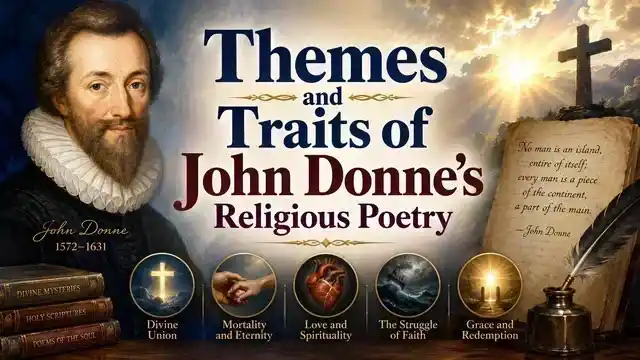
The themes of John Donne’s religious poetry revolve around the eternal relationship between humanity and God. His poems explore universal concerns such as sin, repentance, divine grace, salvation, death, immortality, resurrection, divine judgement, human frailty, and the soul’s longing for spiritual union with God. Rather than presenting religion as a set of rigid doctrines, Donne portrays faith as a deeply personal and emotional experience filled with doubt, hope, fear, and ultimate trust in God’s infinite mercy. His poetry reflects the inner conflict between worldly desires and spiritual aspirations, making his religious verse both intellectually stimulating and emotionally moving.
One of the most remarkable traits of Donne’s religious poetry is its metaphysical style. His poems are characterized by ingenious conceits, striking paradoxes, intellectual arguments, dramatic openings, logical reasoning, and vivid imagery drawn from theology, philosophy, science, astronomy, medicine, and everyday life. These unconventional poetic techniques enable Donne to express complex spiritual truths with extraordinary originality. His language combines passionate emotion with rigorous intellect, creating poetry that appeals simultaneously to the heart and the mind.
Another defining characteristic of Donne’s religious poetry is its intense introspection. He examines his own conscience with honesty and humility, confessing his sins while seeking God’s forgiveness and mercy. His famous Holy Sonnets reveal a soul engaged in a constant struggle between despair and hope, guilt and redemption, fear and faith. Even when confronting death, Donne displays remarkable spiritual courage, viewing it not as the end of existence but as the gateway to eternal life. His celebrated poem “Death Be Not Proud” exemplifies his triumph over the fear of death through unwavering Christian faith.
John Donne’s religious poetry also reflects the influence of Christian theology, particularly the doctrines of the Anglican Church. However, his poems transcend theological boundaries by addressing universal questions about human existence, mortality, and the search for divine truth. His ability to unite profound religious devotion with intellectual brilliance makes his poetry timeless and universally relevant.
In conclusion, the themes and traits of John Donne’s religious poetry reveal a poet who transformed personal spiritual struggles into works of enduring literary and philosophical significance. Through his exploration of faith, sin, redemption, divine love, and eternal life, combined with his innovative metaphysical style and psychological depth, Donne elevated religious poetry to one of the highest achievements in English literature. His sacred verse continues to inspire readers with its profound insights into the human soul, the nature of God, and the eternal quest for spiritual fulfilment.
Donne’s Religious Poetry:
John Donne is one of the greatest of English religious poets. No doubt Donne’s religious poetry belongs to the later part of his career, to the period after his ordination, and the gloom, despair and frustration which resulted from the death of his wife, poverty, and ill health. The earliest of his religious poems are the sonnet – sequence called La Corona and The Litanie, The best of his religious poetry is contained in the Holy Sonnets, The Divine Poems, and The Three – Hymns. Donne’s chief power as a religious poet is shown in the Holy sonnets and last hymns. He treats God as a conqueror of a ravisher. In his religious poetry, there is considerable variety of tone and method, ranging from casuistry and debating tricks to a profound urgency and conviction, and sometimes both may be found in the same poem. Donne is the first of the introspective, Anglican, religious poets of the seventeenth century.
Themes of Donne’s Religious Poetry:
Search for true religion is the theme of his early religion poems contained in La Corona and The Litany, but in passionate holy sonnets he imagines himself to be in presence of God, confesses that he is great sinner, and prays directly or indirectly for God’s mercy and favour. The theme of the frailty and decay of this world is generally the subject of Donne’s religious poems. Other important themes of Donne’s religious poems are the insignificance of man himself, the antithesis between the world and the spirit, the transitoriness and unsatisfactoriness of all earthly enjoyments, the pangs suffered by the soul in the imprisoning body. In short, true religion, fear of death and damnation, love of God and hope of salvation are the themes of Donne’s religious poetry.
The Main Characteristics of His Religious Poetry:
(1) The Stamp of His Personality:
Donne’s religious poetry bears an unmistakable stamp of his personality. It is highly individualistic and personal as well Donne’s poetry is, and it gives expression to his highly complex personality. His best religious poetry is intensely personal. It is passionate and dramatic prayer to be delivered from temptations and distractions. If religion is defined, it may be said that Donne’s poetry is in this widest sense religious, but only accidentally or incidently Christian.
(2) Religion in True Way:
The poet is concerned, not with subtleties of doctrine, with the infinite subtleties of temptation from which he asks to be delivered, with the innumerable wandering by – ways and mazes that would entice him from the straight and narrow path. The religion which gives such passion to his poems is religion in its most primary and fundamental sense; what Donne asks for is purgation, purification, illumination— a directing of heart.
His Looking Religion for an Evenness of Piety:
Like Wordsworth in his middle years, he came to long for a repose that ever is the same. He did not look religion for an ecstasy of the spirit which would efface the memory of the ecstasy of the flesh, but for an evenness of piety which would preserve him from despair. The struggles and conflicts to which the Divine Poems witness did not lead to the secret heights and depths of the contemplative life, but to the public life of duty and charity.
Christianity in His Divine Poems:
In his divine poetry feeling and thought are judged by the standard of what a Christian should feel or think. He cannot escape using the language of the Bible, and of hymns and prayers, or remembering the words of Christian writers. Christianity is a revealed religion, contained in the scriptures and the experience of Christian souls. The truths of revelation are the accepted basis of his religious poetry.
Awe of Death and Damnation:
The poet admits the movement of time, decay and death. The death of Sir Robert Druary’s young daughter Elizabeth and his composition of the two Anniversaries on her death made him feel that his own lot is not secure. In The First Anniversary, he writes:
“Her death hath taught us dearly, that thou art
Corrupt and mortal in thy purest part.”
In The Second Anniversary, he describes man’s lot:
“Though he hath might and power and place, before,
Yet Death must usher, and unlock the door.”
In A Hymn To God the Father, the poet again expresses his fear of death and damnation:
“I have a sin of fear, that when I have spun
My last thread, I shall perish on the shore.”
His Philosophical and Learned Reasons:
His religious poetry is packed with philosophical and learned reasons. In the sonnet If Poisonous Minerals, the poet writes that poisonous minerals, the forbidden tree, the lustful goats, the treacherous and malicious serpent which was the Devil himself—all were greater sinners than he. In Death Be Not Proud, he, consoles himself with the argument that Death is only a short sleep after which we wake up eternally.