Introduction of the Poem:
“The Whorehouse in a Calcutta Street” is one of the most powerful and socially conscious poems by Jayanta Mahapatra, one of India’s foremost contemporary English poets. The poem presents a stark and realistic portrayal of a brothel in Calcutta (now Kolkata), exposing the harsh realities of poverty, exploitation, moral decay, and human suffering. Rather than treating prostitution as a subject of sensationalism, Mahapatra explores it with deep compassion and psychological insight, revealing the tragic circumstances that force women into such a life.
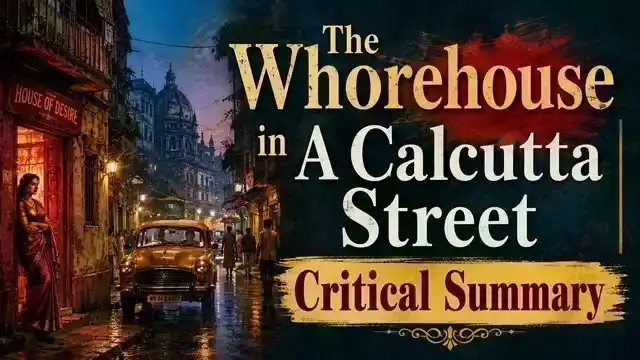
Through vivid imagery, symbolic expressions, and an intensely reflective tone, the poet highlights the loss of human dignity and the emotional emptiness hidden behind physical desire. At the same time, the poem serves as a powerful critique of a society that ignores the pain of its marginalized people while perpetuating injustice and hypocrisy. Rich in symbolism and social realism, “The Whorehouse in a Calcutta Street” stands as a profound meditation on human misery, alienation, and the search for compassion in an indifferent world.
This poem shows the dilemma of a person who is invited to visit a brothel. While he wants to find out how a prostitute behaves or how the mind of a prostitute works, the woman immediately gets down to “business” to please him as a “passionless tool” so that she can sexually gratify him and move on to the next customer. He tries to plumb the depths the woman’s soul and her inner longings, but for her it is pure business and does not touch her private self. The failure of communication, says C.L.L. Jayaprada, is not exclusive to the experience with a whore. The condition of the modern man is itself solitary and alienated. According to K.A. Paniker, The Whorehouse in a Calcutta Street shows both the strength and weaknesses of Mahapatra as a poet. The first and the last stanzas in the poem have the same quality of tightness, sharpness and precision as Hunger possesses. But the middle sections are lax, verbose and over – literal.
Critical Summary:
The speaker invites a potential client into a brothel, telling him that he should consider himself owner of the place. For a moment the customer would think that the house is smiling, as if it is amused at the entrance of another customer. The speaker asks him to imagine all those alluring women whose faces he has seen in various advertisements in print or on the hoardings, whom he wanted to have but could never have and would never be able to have. The whorehouse is the place where a customer may expect to see some faces similar to those he has seen on the posters and which he had longed for.
The customer is somewhat ashamed of visiting the whorehouse. The courtyard of the place seems to be a partner in the conspiracy that is a routine in all such places of ill – repute, with the customer being its target: It fails when a customer goes away without choosing a prostitute for his sexual gratification; it succeeds if the customer chooses a woman, pays for her and leaves after having sex with her. If the customer feels ashamed of having come here, he should think of the women he has left behind, women who are childless and are longing to have children; they merely satisfy their longings by imagining that they have children.
While moving back a little in the dim light of a room in the whorehouse, the customer collides against a whore who has just stepped into the room to be surveyed by him; he selects her. He has not come here only to satisfy his sexual desire but also to learn a little more about the psychology of a woman, how a prostitute behaves and how her mind works. For this, he wants to talk to her, watch her and observe her. But she straightaway gets down to her professional duties that she routinely performs to please a customer. She starts fondling him mechanically, employing all the techniques that she knows so that the customer is pleased and visits her again.
The whore’s initiatives in having sex with the customer reveal to him his own inner being. He cannot command his inner being because there is a conflict between the conscious and the sub – conscious working of his mind. He has always been opposed to this sort of instant sexual gratification. Sometimes he has a strong urge to dismantle these houses of prostitution. He is shocked when the whore harshly asks him, “Hurry, will you? Let me go.” Her words seem to “thrash” the man because he has been expecting some kind of an emotional response from her while she (a professional whore) wants to finish the business in hand and get away from him as quickly as possible to wait for the next customer and the next payment.
Critical Analysis of “The Whorehouse in a Calcutta Street”:
Introduction
“The Whorehouse in a Calcutta Street” is one of Jayanta Mahapatra’s most powerful and disturbing poems, exposing the harsh realities of prostitution, poverty, exploitation, and moral decay in Indian society. Rather than presenting the brothel merely as a place of physical desire, Mahapatra transforms it into a symbol of social injustice and human suffering. The poem vividly portrays the dehumanization of women who are trapped in a cycle of poverty and exploitation, while simultaneously criticizing a society that silently accepts such inhuman conditions. Through stark imagery, irony, and emotional depth, the poet compels readers to confront uncomfortable truths about humanity.
Theme of Human Exploitation
The central theme of the poem is the exploitation of vulnerable women. The prostitutes are not depicted as immoral individuals but as helpless victims of poverty and social inequality. They have been forced into a profession that strips them of dignity, identity, and freedom. Their bodies become commodities to be bought and sold, reducing human life to mere economic transactions. Mahapatra emphasizes that the true guilt lies not with these women but with the social and economic systems that leave them with no alternative.
Poverty as the Root Cause
Mahapatra highlights poverty as the primary force driving women into prostitution. Economic deprivation destroys dreams, relationships, and personal identity. Families often abandon or exploit women, leaving them with limited choices for survival. The poet suggests that prostitution is not simply a moral issue but a consequence of widespread social injustice and economic inequality. By linking the brothel to poverty, he encourages readers to understand rather than judge its inhabitants.
Loss of Human Dignity
A dominant concern in the poem is the gradual erosion of human dignity. Inside the brothel, emotions, love, and individuality disappear. Women become objects of desire rather than respected human beings. Their identities are erased, and their existence revolves around satisfying the temporary desires of strangers. Mahapatra’s portrayal evokes sympathy instead of condemnation, reminding readers that every individual deserves compassion and respect regardless of their circumstances.
Symbolism of the Whorehouse
The whorehouse functions as a powerful symbol throughout the poem. It represents not only a place of prostitution but also a society corrupted by hypocrisy, greed, and indifference. The brothel becomes a miniature version of a world where human values are sacrificed for material gain. Darkness, confinement, and decay symbolize the emotional and moral imprisonment experienced by its inhabitants. Thus, the whorehouse reflects the larger failure of society to protect its most vulnerable members.
Social Criticism and Moral Hypocrisy
Mahapatra sharply criticizes the hypocrisy of society. Respectable citizens publicly condemn prostitution while secretly sustaining it through their own actions. Society blames the women but ignores the economic conditions and male desires that perpetuate the system. The poet exposes this double standard, questioning the morality of those who judge the victims while remaining silent about the real causes of exploitation. His criticism extends beyond individuals to the entire social structure that tolerates injustice.
Realistic Imagery and Poetic Technique
The poem is marked by vivid and realistic imagery that creates a disturbing yet unforgettable picture of life inside the brothel. Mahapatra avoids romanticizing the subject and instead employs direct, concrete descriptions to evoke pity and reflection. His free verse style, conversational tone, and carefully chosen symbols strengthen the emotional impact. The absence of decorative language mirrors the bleakness of the women’s lives, making the poem more authentic and powerful.
Psychological and Emotional Depth
Beyond its social message, the poem explores the emotional emptiness experienced by both the prostitutes and their customers. Physical intimacy fails to provide genuine human connection. Loneliness, despair, and alienation dominate the atmosphere. The women continue their mechanical existence without hope, while the visitors seek temporary escape from their own emotional voids. This psychological dimension gives the poem universal significance, showing that exploitation damages both victims and exploiters.
Universal Relevance
Although the poem is set in a street in Calcutta (now Kolkata), its concerns are universal. Human trafficking, gender inequality, poverty, and the commercialization of the human body remain pressing issues across the world. Mahapatra’s portrayal transcends geographical boundaries and continues to resonate with modern readers. The poem reminds us that genuine social progress cannot be achieved until every individual is treated with dignity and compassion.
Style and Language
Mahapatra’s language is simple, direct, and intensely evocative. He combines realism with symbolism to create multiple layers of meaning. His restrained emotional tone prevents the poem from becoming sentimental while allowing the suffering of the characters to speak for itself. The free verse structure reflects the fragmented and uncertain lives of the people portrayed, enhancing the poem’s realism and emotional force.
Conclusion
“The Whorehouse in a Calcutta Street” is a profound social protest against exploitation, poverty, and moral hypocrisy. Jayanta Mahapatra transforms a local setting into a universal symbol of human suffering and injustice. Through powerful imagery, symbolic depth, and compassionate realism, he challenges readers to look beyond superficial moral judgments and recognize the social conditions that destroy human dignity. The poem remains one of Mahapatra’s most significant works, offering a timeless reflection on compassion, inequality, and the urgent need for social justice.