Introduction:
William Golding’s Lord of the Flies is one of the most profound novels of the twentieth century, celebrated for its deep moral and philosophical vision. Published in 1954, the novel goes far beyond the story of a group of schoolboys stranded on a deserted island after a plane crash. It serves as a powerful allegory that explores the eternal conflict between civilization and savagery, reason and instinct, morality and immorality, and order and chaos. Through the gradual moral decline of the boys, Golding examines the darker aspects of human nature and challenges the optimistic belief that human beings are naturally good. The novel presents a pessimistic yet realistic view of humanity, suggesting that evil is not merely a product of society but an inherent element within every individual.
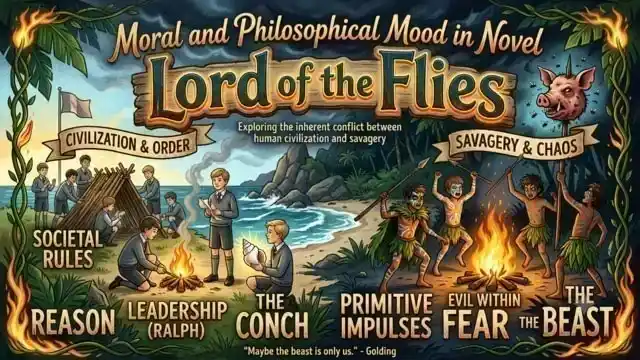
The moral mood of Lord of the Flies is reflected in Golding’s portrayal of the collapse of ethical values and social order when external authority disappears. At the beginning, the boys attempt to establish a civilized society based on cooperation, discipline, justice, and democratic leadership under Ralph. However, fear, selfish ambition, and the desire for power gradually destroy these moral principles. The rise of Jack’s dictatorship and the brutal murders of Simon and Piggy symbolize the triumph of cruelty over compassion and reason. Golding thus conveys the moral lesson that civilization survives only through self-control, responsibility, and respect for moral values, while the absence of these virtues leads to violence and destruction.
Philosophically, the novel raises fundamental questions about human existence, the nature of evil, freedom, authority, and the foundations of civilization. Golding rejects the idealistic philosophy of thinkers such as Jean-Jacques Rousseau, who believed that human beings are naturally innocent and corrupted only by society. Instead, his vision is closer to the ideas of Thomas Hobbes, who argued that human life without law and government descends into chaos, conflict, and brutality. The island becomes a symbolic laboratory where Golding demonstrates that civilization is only a thin veneer covering humanity’s primitive instincts. The “Lord of the Flies” itself symbolizes the evil residing within the human mind, while Simon’s encounter with the pig’s head reveals the philosophical truth that mankind’s greatest enemy is not an external force but the darkness within the human soul.
Another important philosophical dimension of the novel is its exploration of fear and its influence on human behaviour. The boys’ irrational fear of the imaginary “beast” gradually destroys their ability to think logically and morally. Golding suggests that fear can manipulate individuals, create false beliefs, and justify violence, making it one of the greatest threats to civilization. At the same time, the novel emphasizes that knowledge, wisdom, and moral courage, represented by Piggy and Simon, are often ignored or destroyed by ignorant and power-hungry societies.
Ultimately, Lord of the Flies presents a serious moral and philosophical reflection on the human condition. It warns that the survival of civilization depends not merely on laws and institutions but on the moral integrity and self-discipline of individuals. Through its symbolic characters, events, and settings, the novel delivers a timeless message that the struggle between good and evil exists within every human being, and only reason, compassion, and ethical responsibility can prevent society from descending into barbarism. Thus, Golding’s masterpiece remains a universal study of morality, human psychology, and philosophical truth, making it one of the greatest allegorical novels in modern English literature.
It is a novel that reveals Golding’s philosophy that the world should restore principles in an unprincipled world. It should restore belief to a world of disbelieves. This is the hidden appeal and message of the novel Lord of the Flies. A pick of the British boys should have behaved better. This is the message that Golding seems to give through this novel. Whatever be the circumstances in which a British subject finds himself he should hold up traditions, his civilization and not fall into barbarism as the boys under Jack do.
Inner Significance of the Novel:
Novel ‘Lord of the Flies’ has a great inner meaning. Apparently the novel deals with a boyish adventure. A group of British school children crashed on an island in the pacific. They had to adopt themselves to their new tropical surroundings. They start a well – ordered and disciplined life under the leadership of Ralph. Under fear of the beast they break up of their ordered life. Two of them Simon and Piggy are mercilessly killed. Ralph is also hunt down. If he had not turn rescued down by a passing ship, he would have met the same fate – the death. But all this is not the external framework of the novel. There is far more significant inner meaning. The author is disturbed by the presence of evil in the world. He himself says in his own words “Lord of the Flies is an attempt to trace the defects of society back to the defects of human nature.” As the story unfolds of a group of society of half-educated English boys reverting to savagery on a pacific island, the reader witnesses parable of human situation. In it a few cowering hope can be seen by a light too uncertain to fix them in any overall philosophical design. A taste for cruelty is blended with command of fine pathos. It produces an atmosphere which makes the reader shrink while astonishing him at the same time.
Golding’s Moral Problem:
Thus ‘Lord of the Flies’ is like a fragment of nightmare or horrible dream which the reader is compelled to admit that the things could turn out if there are not steps of regression returning or with poetic imagination Golding faces the moral problems of his story in an honest problem. So, Lord of the Flies becomes an allegory of returning from Cathedral chair to tribal savagery. It leaves a better trail of fear humanity and death. So, it is a novel of tragic force and deep moral power.
Story of the Boys from Civilization to Barbarism:
The story of the boys seems to be the story of man on earth in an uncivilized state. They have no fire to cook their food. The story of the boys seems to be the story of man on earth in an uncivilized state. They have no fire to cook their food. They cat fruits and raw meat. In this novel the boys move in the reverse order. They pass from civilization to barbarism. They are cut off from the rest of the world in the coral island. They live in the state as primitive man lived. They eat fruit and drink water from stream and light fire from convex lens or glasses. They start hunting and throw off their clothes and paint themselves. They are away from the group of Ralph with whom they had ordered life. Now they are under Jack who hunts pigs and offers a part of his kill as gift for the Beast. They have now become fell pledged savages.
Prey of Wildest Human Passions:
They chant war songs as the primitive did. They find pleasure in shedding blood. They soon pass from killing pigs to their own fellow beings. They kill Simon in their frenzy. Piggy is murdered by throwing stone at him by the order of Jack. They hunt down Ralph mercilessly. So, they become a prey of wild human passions, anger, fear and enmity. The naval officer is surprised at this change. He had thought that a pack of British boys would have been able to put up a better show.
Novel an exaggeration:
The central theme of the story is adult. The conception that the veneer (covering) of civilization can fall away, under great strain completely is not true. Many novels have been written on this universal theme. But by choosing a group of boys of all types to illustrate, Golding has heightened the drama. People might say that it exaggerated the effect. By allowing Cathedral religious boys to deteriorate so tragically, according to critics author has exaggerated it. He is blamed for it.
Combination of Inner and Outer World:
The story is excellently constructed and worked out. Various children are individualized and with tension built up to the climax of closing Chapter 12. Ralph finds himself outlawed and hunted as a scape goat and sacrificial victim. As the story Lord of the Flies is a very fine romance to the classical tradition. As a philosopher he took all the things for the novel’s plot. Throughout there is a sense of conjunction between the inner or spiritual and the outer or the physical. The author’s sense of animal pain and horror is governed by the sanity of natural historian.
Conclusion:
The whole effect, realistic and anti – mythical is better grounded here. The boys who paint themselves turn savage. Thus, the novel shows that man is a creature of wild passions and inherent evils. In Chapter 8 ‘Lord of the Flies’ says “I am the part of you. The beast and evil is within every man and we cannot escape it, “Man produces evil as bee produces honey”. Civilization cannot change him basically. Hidden evil tendencies may crop up at any moment. This is the inner significance of the novel, ‘Lord of the Flies’.