Introduction:
We find P.B. Shelley’s pantheistic Views in his Poetry. Percy Bysshe Shelley is one of the greatest poets of the English Romantic Age, celebrated for his profound imagination, revolutionary ideals, and intense love of nature. Unlike many poets who regarded nature merely as a source of beauty or inspiration, Shelley viewed it as a living, spiritual force that permeates the entire universe. His poetry reflects a deep belief in the unity of all existence, where the natural world, the human soul, and an eternal spirit are inseparably connected. This philosophical outlook is commonly described as pantheism—the belief that God or the Divine is not separate from the universe but is present in every aspect of nature and existence.
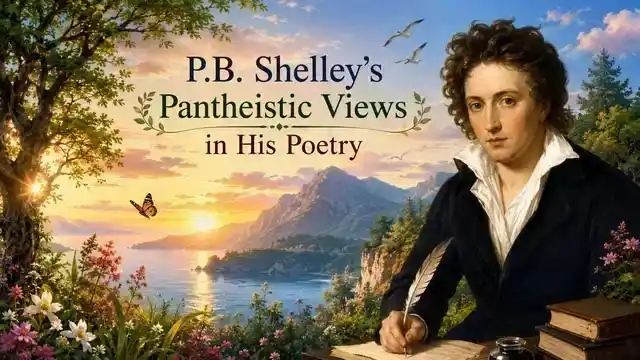
Shelley’s Spiritual Philosophy and Pantheistic Vision:
Shelley’s pantheistic vision evolved through the influence of Romantic philosophy, the ideas of Plato, and his own independent spiritual thinking. Although he rejected the rigid doctrines and institutional practices of organized religion, he possessed a profound faith in an eternal spiritual principle that animates the universe. He believed that every element of nature—the wind, clouds, mountains, rivers, forests, flowers, stars, and the changing seasons—is a manifestation of an infinite, universal spirit. Nature, therefore, is not merely a physical phenomenon but a sacred and dynamic expression of divine power.
Nature as the Living Expression of the Universal Spirit:
In Shelley’s poetry, natural objects are endowed with life, consciousness, and spiritual significance. They are not passive elements of the landscape but active symbols of eternal truth, freedom, beauty, and transformation. The forces of nature often serve as messengers of hope, renewal, and revolution, reflecting the poet’s conviction that the universe is governed by a harmonious spiritual energy. This belief finds magnificent expression in poems such as Ode to the West Wind, Hymn to Intellectual Beauty, Mont Blanc, Adonais, and Prometheus Unbound, where the visible world becomes a gateway to invisible spiritual realities.
Pantheism, Idealism, and Mystical Union:
Shelley’s concept of pantheism is closely linked with his idealism and mysticism. He believed that behind the changing appearances of the material world lies an eternal, invisible reality that can be perceived through imagination, intuition, and poetic vision rather than through reason alone. The human soul, according to Shelley, is capable of experiencing a mystical union with this universal spirit, thereby transcending the limitations of individual existence. Such moments of spiritual communion inspire feelings of peace, joy, freedom, and infinite love.
The Interconnectedness of Humanity and Nature:
Another important aspect of Shelley’s pantheism is his belief in the interconnectedness of all forms of life. He viewed humanity and nature as parts of the same cosmic whole, emphasizing harmony rather than separation. His poetry repeatedly suggests that every living being participates in the universal life-force, and that love is the binding principle that unites all creation. This universal vision encourages compassion, moral progress, and a sense of responsibility toward both humanity and the natural world.
Pantheistic Symbolism in Shelley’s Poetry:
Shelley’s pantheistic philosophy also serves as the foundation of his poetic symbolism. Natural phenomena such as the West Wind, the skylark, clouds, and light are transformed into symbols of divine energy, creative imagination, intellectual enlightenment, and spiritual liberation. Through these symbols, Shelley conveys the idea that nature is not only beautiful but also a revelation of the infinite spirit that governs the cosmos. His poetic imagination elevates ordinary natural scenes into profound reflections on the relationship between humanity, nature, and the eternal.
Shelley as the Poet of Pantheism:
Thus, P.B. Shelley’s poetry presents one of the most comprehensive and inspiring expressions of pantheism in English literature. His vision of the universe as a living, spiritual unity transcends conventional religious boundaries and celebrates the divine presence within nature itself. By portraying nature as the visible manifestation of an infinite and eternal spirit, Shelley invites readers to perceive the world with wonder, reverence, and imagination. His pantheistic outlook remains one of the defining characteristics of his poetry, making him not only a great Romantic poet but also a profound philosopher of nature and the human spirit.
Shelley’s Inclination Toward Pantheistic Thought:
Shelley does not commit himself to definite pantheism anywhere. But there are passages which seem to come near to pantheism. He often conceives of a Spirit diffused through, and permeating the universe — a Spirit that seems also to impel human thoughts. Shelley pays homage to such a Spirit in his Hymn to Intellectual Beauty. It is a spirit that links the very grass we tread under feet with the tremulous stars in the heavens. It, as Shelley says, is reflected in light and colour, in life and motion, which fill every crack and cranny in the universe. Sometimes it stirs the very air and weaves a spell of radiance. Shelley does often experience it in a thrill of thought. Shelley often describes such moments of rapt vision. One passage may be quoted here:
“How calm it was! the silence there
By such a chain was bound
That even the busy woodpecker
Made stiller by her sound
The invisible quietness;
The breath of peace we drew
With its soft motion made not less
The calm that round us grew.
There seemed from the remotest seat
Of the white mountain waste,
To the soft flower beneath our feet,
A magic circle traced,—
A spirit interfused around,
A thrilling silent life.
To momentary peace it bound
Our mortal nature’s strife.” —To Jane: The Recollection.
Pantheism in Adonais:
We have the most definite exposition of his pantheistic views in Adonais. We quote the following as an illustration:
“He is a portion of the loveliness
Which once he made more lovely. He doth bear
His part, while the One Spirit’s plastic stress
Sweeps through the dull dense world; compelling there
All new succession to the forms they wear
Torturing th’ unwilling dross, that checks its flight,
To its own likeness, as each mass may bear;
And bursting in its beauty and its might
From trees and beasts and men into the heaven’s light.”
The Concept of the One Spirit:
The One Spirit is the Universal Mind, working in and through nature, into which are infused life and motion, which is shaped into form and colour and invested with beauty and splendour and as Shelley says here, a poet also bears his part in making the world beautiful. Nature is also a manifestation of the Universal Mind. Pantheism makes Nature and God almost identical. It is the idea of a spiritual principle ruling and pervading the observable world.
Stopford Brooke’s Interpretation of Shelley’s Pantheism:
Stopford Brooke writes, “Shelley was not an atheist or a materialist. If he may be said to have occupied any theoretical position, it was that of an Ideal Pantheist: the position, which with regard to Nature a modern Port who cares for the subject, naturally whatever may be his personal view, adopts in the realm of art. Wordsworth, a plain Christian at home, wrote about Nature as a pantheist. The artist, as I said, loves to conceive of the universe, not as dead, but as alive. Into that belief Shelley, in hours of inspiration, continually rose and his work is seldom more impassioned and beautiful than in the passages where he feels and believes in this manner. The finest example is towards the close of the Adonais. In his mind however, the living spirit which, in its living, made the Universe, was not conceived of a Thought, as Wordsworth conceived it, but as Love operating into Beauty; and there is a passage on this idea in the fragment of the Coliesum which is as beautiful in prose as that of Adonais is in verse. But it is only in higher poetic hours that Shelley seems or cares to realise this belief. In the quieter realms of poetry, in daily life, he confessed no such creed plainly; he had little or no belief in a thinking or loving existence behind the phenomenal universe. It is infinitely improbable, he says, that cause of the mind is similar to mind. Nothing can be more characteristic of him – and he has the same temper in other matters – than that he should have a faith with regard to a Source of Nature, into which he could soar when he pleased, in which he could live for a time, but which he did not choose to live in, to define, or to realise, continually.”
Santayana’s View: Pantheism or Panpsychism?:
However, Santayana in his work The Winds of Doctrine feels that the philosophy expressed by Shelley in his nature poems like Adonais is not “Pantheism” but “panpsychism”. Panpsychism believes that all nature has a psychic (or spiritual) side. Shelley also shows that Nature has an all – pervading Spirit.