Introduction:
Thomas Gray’sAn Elegy Written in a Country Churchyardis one of the greatest and most celebrated elegiac poems in English literature. First published in 1751, the poem reflects upon death, human destiny, the transitory nature of life, and the forgotten lives of ordinary people buried in a quiet village churchyard. Written during the transitional period between Neoclassicism and Romanticism, the poem combines classical restraint with deep emotional sensitivity and a profound love of nature. It occupies a unique place in English poetry because it universalizes the experience of death and emphasizes the dignity and worth of humble human lives.
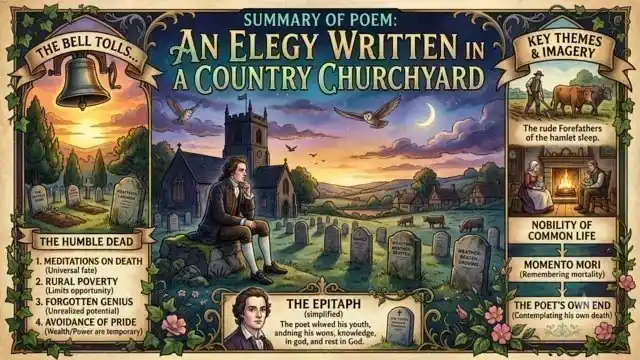
The poem is set in the peaceful surroundings of a rural churchyard at dusk. As evening descends and silence spreads across the landscape, the poet meditates on the graves of unknown villagers. Observing their resting place, he reflects that death is the inevitable destiny of every human being, whether rich or poor, famous or obscure. The villagers buried there may have possessed extraordinary talents or noble qualities, but poverty and lack of opportunity prevented them from achieving greatness. Thus, Gray pays tribute to the common people whose lives, though unnoticed by history, were equally valuable and meaningful.
One of the central themes of the poem is the universality and inevitability of death. Gray reminds readers that wealth, power, beauty, and social status cannot protect anyone from mortality. Kings, scholars, warriors, and peasants all ultimately share the same fate. The poem therefore criticizes pride, ambition, and worldly glory while encouraging humility and compassion. Through memorable reflections, Gray teaches that true greatness lies not merely in fame or achievement but also in virtue, simplicity, and moral integrity.
Another significant feature of the poem is its sympathetic portrayal of rural life. Gray idealizes the peaceful existence of the villagers, appreciating their honesty, hard work, family affection, and contentment. Instead of glorifying aristocratic life, he honours ordinary men and women who lived simple but respectable lives. This democratic spirit was innovative for its time and later influenced many Romantic poets, including William Wordsworth, who also celebrated common people and rural landscapes.
Nature plays an equally important role in the poem. The calm evening scene, the fading daylight, the tolling church bell, the lowing cattle, the hooting owl, and the quiet graves create an atmosphere of solemn beauty and reflective melancholy. These vivid natural images do not merely provide a background but reinforce the poem’s meditation on mortality, silence, memory, and the eternal cycle of life and death. Gray’s rich imagery and musical language make the poem one of the finest examples of descriptive and meditative poetry.
The poem also contains philosophical reflections on fame, ambition, and remembrance. Gray suggests that many gifted individuals remain unknown because circumstances deny them the opportunity to develop their talents. He reminds readers not to judge the poor harshly, for among them may have been potential statesmen, poets, or heroes whose abilities remained hidden. In this way, the poem expresses sympathy for human limitations while affirming the equal worth of every individual.
Stylistically, An Elegy Written in a Country Churchyard is admired for its polished diction, harmonious rhythm, vivid imagery, personification, and thoughtful symbolism. Written in heroic quatrains (also known as Elegiac Stanzas), with an ABAB rhyme scheme, the poem achieves remarkable balance between emotional depth and artistic perfection. Gray’s language is refined yet accessible, making the poem both intellectually stimulating and emotionally moving.
In conclusion, An Elegy Written in a Country Churchyard is far more than a meditation on death; it is a timeless philosophical poem celebrating humanity, equality, humility, and the enduring value of ordinary life. Its universal themes, profound moral insight, beautiful natural imagery, and reflective tone have ensured its lasting place as one of the masterpieces of English literature. Even today, the poem continues to inspire readers by reminding them of the inevitability of death, the importance of compassion, and the dignity inherent in every human life.
Summary of the Poem:
Stanza 1:
The evening bell has warned people to cover their fires, put out their lights, and go to bed. The crying group of animals is going on tract with farmers walking with tired steps leaving all in darkness.
Stanza 2:
There disappears the faint shine and a holy silence suggestive of death dominates the sight. The silence is disturbed by beetles that fly in circle and produce the sound of buzzing. Sleeping animals’ bells produce light sound that makes them asleep in the distant enclosures for sheep. At some distance on the tower of the church at Stock Poges is covered with creepers, there shines the moon that disturbs the owl. The sad owl takes rest at a dark place of residing that is disturbed by the moonlight.
Stanza 3:
The poor draws a lively word picture of the churchyard. Under rough hedge trees and trees with thick dark green leaves dry grass moves hither and thither with wind. There are graves decaying to dust. Dead bodies or uneducated villagers are laid in graves. The pleasant morning has no importance for the dead in graves. The poet regards the morning as a person; that is, he personifies morning. Personification is seldom used now, but the eighteenth-century poets delighted in it. It is frequently employed in this poem. No music by birds or alarm by the cock would rouse them from their graves.
Stanza 4:
The poet feels sorry for those farmers who are no more. Now no stove is burnt for them. The housewives do not care for evening duties and children do not wait for their return. They have no wish for kiss. When they were alive they used to cut the harvest with their sickles. Their plough used to break hard soil with their strong attacks. They used to drive their bulls quite happily to their fields.
Stanza 5:
Ambitious people should not laugh at useful labour of these villagers. Their simple joys and dark future ought to be respected. Royal persons should not be scornful to their simple tales of life. The pride of royal birth and show of power, beauty or wealth prove useless for unavoidable moment of death waits equally for all. The ways of worldly progress end in grave.
Stanza 6:
The poet warns those who are proud enough to blame the poor farmers for not having memorials for their dead forefathers. It was the custom to bury the poorer people of a village in the churchyard, and the rich or high-born in the church. But the poet does not regard it a matter to be proud of for all these vain customs or formalities are meaningless. The loud songs of their false praise cannot make them alive. The funeral urns such as were used by the ancients were frequently decorated with scenes from the life of the deceased or life-like statues can’t call back the dead man to life. The dead body has no sense to hear speeches of sycophancy made to please the dead.
Stanza 7:
In these poor graves those unfortunate persons’ dead bodies are laid who were inspired with divine blessing. They were talented enough to hold the sceptre and rule a state. On getting proper opportunity they might have played on a musical instrument and thrilled the souls of all listeners. They were devoid of scholarship. They were ignorant of the wide range of knowledge and treasure of time. Their discouraging poverty crushed their enthusiasm and disheartened their talent. In this condition they remained uneducated and backward.
Stanza 8:
A number of pearls of true excellence are hidden in unknown and unmeasured caves of the sea, therefore, nobody knows about them and they remain neglected. In the same way there are a number of flowers that fade in desert and there is none to value their beauty and fragrance.
Stanza 9:
The poet imagines that on getting proper opportunity some of these villagers could be great like Hampden. John Hampden was an English patriot who refused to pay taxes levied by the King without the consent of Parliament. He died in 1643 from a wound received while fighting for the liberties of England. His fearless heart showed the power of common men. Some of these villagers could be great poets like Milton. John Milton, the author of Paradise Lost, is generally ranked as the greatest English poet after Shakespeare. Some of these villagers could be great leaders like Cromwell. Oliver Cromwell, the famous Protector, is now regarded by historians in general as one of the foremost champions of English liberty. It was the want of opportunity that these poor villagers could not make progress in life.
Stanza 10:
These villagers had no opportunity for getting praise or holding meeting as member of senate. On getting proper opportunity they also could make emotional fiery speeches against threats to nation and shower blessings on a host of common people. On holding a high post they could see people expressing gratitude to them for their service to nation. But they could not get these opportunities for their ways of making progress were obstructed by their poverty. But the want of opportunity made them deprived of not only worldly progress but also free from evils. They never tried to proceed through wide spread bloodshed. They never tried to be cruel to rule.
Stanza 11:
These farmers were free from the mental conflict to choose between truth and progress by hiding the truth. They were free from the possibility of getting insulted on the discovery of shameful act. They did not erect majestic buildings to lead a life of luxury and take pride in that. They could not be blamed for misusing the scholarship for flattering others. They were devoid of foul deeds of worldly people. They had limited requirements. They were not spoiled by over-ambition. They were free from hustle of worldly life. They led a peaceful life living in contentment.
Stanza12:
To save the dead bodies of poor farmers from being insulted poor graves of clay are always made. With imperfect verse, the poor graves are decorated. The grave requests for a bit of formal sympathy from all the passersby. Their name, their years were spelt by the unlettered Muse. In Greek mythology the Muses were nine goddesses who presided over the arts and sciences, song, and the different kinds of poetry. The true poet was supposed to be inspired by them. Gray imagines a new kind of Muse who inspires the writers of crude epitaphs. Their unrefined poetry becomes an elegy for them. Lines from the Bible are written round the grave to inspire them to die in peace.
Stanza 13:
The poet asks who is not victim of death is and who gives up the life full of joy and sorrow quite willingly. In fact, nobody welcomes death. Everybody dies with desire of living more. Every dying person has faith on a particular friend or relative and hands over his responsibilities to him. The dying person expects some true tears in the eyes of his near and dear ones. Whenever they see his grave, they think about liking and disliking as well as dreams and hopes of the dead. It reminds of the incomplete wishes of the dead.
Stanza 14:
The poet fears that nobody would think about him. Gray refers to himself as the writer of this poem. If perchance by a passing thought a gentle man enquires about his welfare. Perhaps a country gallant or lover would report that in the morning he could be seen walking fast. At sun-set he used to visit a cleared place in a wood, not cultivated. Now, of course, the word always means grassland near a house which is kept closely cut.
Stanza 15:
It would be told about Gray that there at the foot of distant forest tree that decorates its old fantastic roots so high. His dull time at midday he would spend there and look attentively the stream that flows by it. He used to wander in the distant wood, smiling as in scorn, lost in his wayward thoughts he would wander. He was a dull sorrowful man, like one cheerless, or an unfortunate man mad with care, or rejected in hopeless love.
Stanza 16:
He would say that daily he used to see Gray on a hill but one morning he missed him on that hill. Along the open uncultivated ground, and near his favourite forest tree. Another day came but Gray was not seen even beside the stream. Gray was seen neither up the lawn, nor at the wood. The next day with dirges and in sad black mourning clothes he saw some people walking slow through the church-way path. He saw him borne to be buried. He asks those who enquire about Gray to go and read the lines engraved on the stone beneath distant aged thorn-bush.
Stanza 17: The Epitaph
Gray imagines the inscription upon the stone of his grave. In this grave in the lap of earth a young man is taking rest. He was unknown to success and honour. He was blessed with knowledge in general. Knowledge was not angry on his poverty. There was no want of sorrows in his life. His large-heartedness had made him helpful to others. There is no need to go far to know his qualities or weaknesses. After death he has got a place in the bosom of God.