Introduction:
Porphyria’s Lover is one of the most remarkable dramatic monologues by Robert Browning, first published in 1836. The poem explores the disturbing workings of a diseased human mind through the voice of an unnamed speaker who recounts the murder of his beloved, Porphyria. Rather than presenting the crime as an act of hatred or revenge, Browning delves into the psychological motives that compel the lover to kill the woman he passionately adores. The poem is a profound study of obsession, possessive love, emotional insecurity, madness, and the dangerous desire to preserve a perfect moment forever. By allowing the murderer to narrate his own actions calmly and rationally, Browning reveals the terrifying gap between appearance and reality, exposing the fragile boundary between love and insanity.
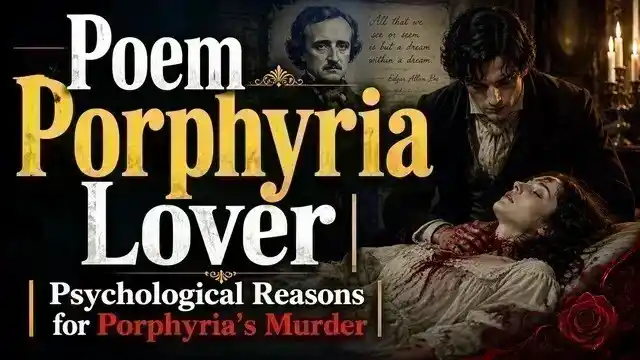
From a psychological perspective, the murder of Porphyria is not a crime of passion in the ordinary sense but the result of the speaker’s deeply disturbed mental state. He suffers from an overwhelming fear of losing Porphyria, intense feelings of inferiority, and an obsessive need to possess her completely. When he believes that Porphyria has finally surrendered herself to him in perfect love, he decides that the only way to preserve this ideal moment eternally is to kill her. In his distorted reasoning, death freezes her beauty, devotion, and affection forever, ensuring that she can never change her feelings or leave him. His repeated attempts to justify the murder reveal a mind suffering from delusion and moral confusion rather than genuine rationality.
The poem also reflects Victorian concerns about social class, repression, and psychological instability. Porphyria appears to belong to a higher social position and is constrained by social obligations that prevent her from openly uniting with her lover. The speaker interprets these circumstances through the lens of his own insecurity and emotional dependence, transforming them into evidence that only death can permanently unite them. His calm narration, absence of remorse, and conviction that “God has not said a word” further highlight his complete psychological detachment from reality and his inability to distinguish between love and violence.
Ultimately, Porphyria’s Lover is far more than a narrative of murder; it is a penetrating psychological study of obsessive love, possessiveness, narcissism, and insanity. Through the speaker’s chilling self-justification, Robert Browning demonstrates how uncontrolled emotions and delusional thinking can corrupt genuine affection into destructive obsession. The poem remains one of the finest explorations of the human psyche in Victorian literature, inviting readers to examine the complex relationship between love, power, identity, and madness while exposing the catastrophic consequences of psychological imbalance.
The Lover’s Romantic Egotism and Self-Delusion:
The “Porphyria” persona’s romantic egotism leads him into all manner of monstrously selfish assumptions compatible with his own longings. He seems convinced that Porphyria wanted to be murdered, and claims “No pain felt she” while being strangled, adding, as if to convince himself “I am quite sure she felt no pain”. He may even believe she enjoyed the pain, because he, her lover, inflicted it. When she is dead, he says she’s found her “utmost will”, and when he sees her lifeless head drooping on his shoulder, he describes it as a “smiling rosy little head”, possibly using the word rosy to symbolize the red “roses” of love, or to demonstrate his delusion that the girl and their relationship are still alive.
Debate over the Lover’s Sanity:
Most commentators are of the opinion that the lover is insane, Rober Langbaum in The Poetry of Experience says, “The speaker is undoubtedly mad.” But it does not seem to be a convincing explanation because the manner in which the lover has narrated the story does not indicate any disorder in his mind. Another explanation is: “Such a crime might be committed in a momentary aberration, or even intense excitement, of feeling.” This view is also not acceptable since there is no remorse or regret after committing murder. Rather he was glad and proud of preserving unchanged the perfect moment of her surrender to him. People often commit horrible deeds in moments of intense mental excitement, but afterwards they feel remorse for the act.
Absence of Remorse and Psychological Interpretation:
There is no remorse in the case of this lover. Another comment on the murder is: The poem describes how a man strangled his love in the insane idea of so preserving her passion for himself from deflection. This view treats the poem as a study of “ingenuity” rather than of intense mental excitement or of madness. One more comment on the murder is that of H.C. Duffin who thinks that the lover only pretended to murder Porphyria. He says, Porphyria’s Lover is a case of study of psychological deviationism. The psychological reasons for the murder of Porphyria may be examined along the following lines:
(1) Fear of Losing Porphyria’s Beauty:
He thought that she was looking glamorously beautiful then, when she grew older, she might grow less beautiful, so it was best to kill her just then in order to preserve the memory of her beauty intact. The lover says:
“The moment she was mine, mine, fair,
Perfectly pure and good.”
The lover strangled his love in the insane idea of preserving her beauty from deflection.
(2) Sense of Inferiority and Emotional Insecurity:
He was also perhaps afraid that he might be wanting in vitality compared with her. He resorted to murder because of an acute sense of inferiority, of inadequacy in himself. The pale lover knew that Porphyria was too weak – willed to free her passion from pride and vanity. He murdered her in the moment of her intense passion for him because he wished to preserve unchanged the perfect moment of her surrender to him.
(3) Obsession with Perfection Through Death:
His diseased mind identified perfection with death or murder. The homicidal tendency might have asserted itself at the moment when he was most vulnerable. He was not able to curb the animal instinct found in most of the human beings. The lover in the poem is obsessed with one idea. This obsession is destructive to the man himself.