Introduction:
W. H. Auden Auden (1907–1973) occupies a distinguished place in twentieth-century English literature as one of the most influential and intellectually profound poets of the modern age. He emerged as the leading voice of the 1930s generation, a decade marked by political unrest, economic depression, the rise of fascism, and the growing threat of another world war. Auden’s poetry reflects the anxieties, uncertainties, and moral dilemmas of this turbulent period with remarkable clarity, originality, and artistic brilliance. Because of his deep engagement with the social, political, and psychological issues of his time, he is widely regarded as the foremost modern poet of the 1930s.
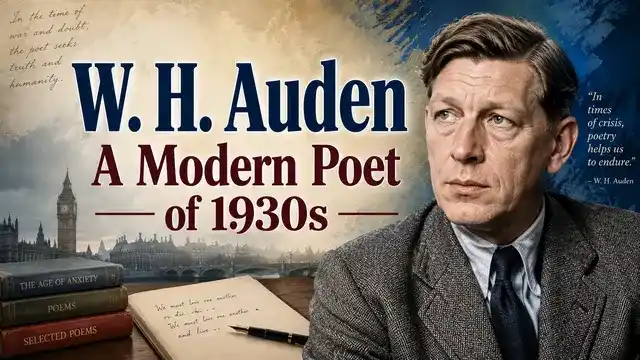
Unlike the highly complex and often obscure poetry of earlier modernists such as T. S. Eliot and Ezra Pound, Auden sought to make modern poetry more accessible without sacrificing its intellectual depth. His poems combine a wide range of influences—from psychology, philosophy, history, and politics to religion and mythology—creating a unique poetic voice that is both analytical and emotionally moving. He skillfully blended traditional poetic forms with modern techniques, employing irony, satire, symbolism, conversational language, and vivid imagery to explore the complexities of modern civilization.
The decade of the 1930s profoundly shaped Auden’s literary outlook. The Great Depression, the Spanish Civil War, the spread of totalitarian ideologies, and the collapse of old social values deeply affected his imagination. Consequently, his early poetry reveals a strong sense of social responsibility and political awareness. He believed that poetry should not merely provide aesthetic pleasure but should also awaken readers to the realities of their age. His works examine themes such as alienation, fear, injustice, moral responsibility, love, war, loneliness, and the search for meaning in an increasingly fragmented world.
Auden also brought a psychological dimension to modern poetry by drawing upon the theories of Sigmund Freud. He explored the hidden motives, fears, and emotional conflicts of individuals living in an unstable society. His poetry presents modern man as isolated and spiritually restless, struggling to reconcile personal desires with social obligations. At the same time, Auden’s later works reveal a growing concern with religion, ethics, and the possibility of spiritual redemption, demonstrating the remarkable evolution of his poetic vision.
One of Auden’s greatest achievements lies in his extraordinary technical mastery. He experimented with a wide variety of verse forms, rhythms, and styles, ranging from ballads and sonnets to dramatic monologues and free verse. His ability to adapt traditional forms to modern themes gave his poetry freshness, vitality, and enduring appeal. His language is distinguished by precision, wit, irony, and intellectual sophistication, while remaining capable of expressing deep human emotions.
As the central figure of the “Auden Generation” or the “Poets of the Thirties,” Auden profoundly influenced contemporaries such as Stephen Spender, Cecil Day-Lewis, and Louis MacNeice. Together, they transformed English poetry by making it more responsive to the pressing social and political realities of the modern world. Auden’s works, including Poems (1930), The Orators (1932), Look, Stranger! (1936), Spain (1937), September 1, 1939, and The Age of Anxiety (1947), continue to be celebrated for their intellectual depth, artistic excellence, and universal relevance.
In conclusion, W. H. Auden stands as the quintessential modern poet of the 1930s because he successfully captured the spirit of an age characterized by crisis, uncertainty, and rapid social change. His poetry combines modernist innovation with moral seriousness, psychological insight, and social commitment, making him one of the greatest voices in English literature. Through his profound exploration of the human condition and his masterly craftsmanship, Auden transformed modern poetry into a powerful medium for understanding both the individual and society, securing his permanent place among the greatest poets of the twentieth century.
W. H. Auden A Modern Poet:
W. H. Auden is an outstanding modern poet, standing next only to W. B. Yeats and T. S. Eliot. He justified throughout his career the position he quickly attained as the leader of a generation that followed Yeats and Eliot.
He may not be as profound as Yeats or Eliot, but he is “an intelligent, sensitive, fluent and generous man of his age”, and his poetry is a great civilizing force. The place and significance of this civilizing force can never be obliterated from the pages of the history of English poetry.
A Representative Poet of 1930s:
Auden, like T. S. Eliot, is a representative poet of the 1930s. His characteristic work has always shown an acute consciousness of the modern situation as perceived by the intelligentsia of the time. His poetry of the 1930s is related to the discontents, the mingled sense of guilt and frustration among the upper, upper middle, and professional classes in England after the First World War. He captured the mood of our time. He was ‘modern’, he spoke of the time in which he lived, and dealt with contemporary ideas and topical events. He gave expression to the modern sense of loss as The Waste Land presented. City Without Walls, Auden’s last volume published in his life time , presented the 20th century ethos as forcefully as his earliest volume Poems 1930 attacked a decaying society.
The Modernity of His Sensibility:
Auden’s poetry is made of experiences directly gained from a close understanding of life and a profound concern about its problems. Ours is the age of disintegration, uncertainty and anxiety, and Auden has rightly named it as the ‘Age of Anxiety’. Auden’s concern with the political and social situation in the thirties, his employment of the modern, psychological theories in the interpretation of man’s inner dilemmas, his emphasis on the multi-dimensional of man, his treatment of the problem of anxiety and despair in man’s life, and his final acceptance of religious humility and faith as the unerring solution of these problems place him in the forefront of the representative writers of the 20th century.
The Use of Modern Technique in Poetry:
The stylistic and technical devices employed by Auden in his poetry are modern, too. Younger poets of our time found in him a stylistic chameleon and his technical skill an object of curiosity and envy. He wrote all kinds of poetry in all kinds of styles which is amazing. Even in the small amount of poetry he had written in 1937, he made use of numerous devices. He experimented with new styles ranging from the prose of Henry James ‘ late works to the nursery rhymes of Edward Lear. In between he wrote parodies, songs, ballads, operas, etc. He wanted to explore the potentialities of all possible forms and see what he could do with them. His most brilliant piece of technical virtuosity is Canzone (1945) where sixty – five lines employ only five rhyme words altogether. Since 1945 Auden created for himself a number of new forms which are as challenging as some of the traditional forms. Arbitrary imagery and unusual diction are the natural consequences of the rhyme and line length used, but they help to hide the harshness of language as in Streams. In technical virtuosity Auden is unsurpassable.
His Modernity in the Use of Imagery:
Auden is modern in his use of imagery. The world of science and industry provides Auden with one of his most pervasive types of images. He shows a remarkable capacity to turn the images from the modern civilization of poetic advantage more often than almost any other poet of his age except Eliot. It is through the use of such images as ramshackle engine, rusting rails, deserted mine, unbuilt bridges, smokeless chimneys, evening like a coloured photograph, telegraph pole, drawing room’s civilized cry, negative inversion , the private nocturnal terror, barbed wire , airport , coffee – coloured honey , loud explosions , flu infected city , eye of the camera , fractured towns , a silver cocktail shaker , a transistor radio , and several other images of the ordinary life of the present used mainly in the poems of About the House that the effect of modernity is produced on the one hand , and prodigies of the modern civilization are depicted on the other . It is earthly city that looms large in Auden’s poetry , and the modern industrial and urban images form an important part of the earthly city which is contrasted with the images of the ideal city, the jester life, and the heavenly city of faith.
Complexity of Language:
The main characteristic which strikes us is the extremely difficult nature of his poetry. This difficulty, even obscurity, arises from the extreme density and epigrammatic terseness of his style. He often writes telegraphic style in which connections, conjunctions, articles, even pronouns, are often missing. Further difficulty is created by his frequent use of the terminology of modern psychology. However, it should be mentioned that with the passing of time his style became more clear and lucid, and easy to understand.
A Ceaseless Experimenter with Verse Forms:
Auden was a ceaseless experimenter with verse – forms and stanza – pattern. He began with using conventional 19th century metres, and he continued to use conventional verse – forms upto the very end. However, gradually he took more and more to the use of free verse i.e., verse which has been freed from the bondage of metre. Often he uses a long flowing line which approximates closely to the condition of prose. In his Christian poetry as his diction grows simpler, his rhythms become colloquial and conversational.
The Use of Archaic Words, Transformation of Parts of Speech and Figurative language:
Auden uses a number of stylistic devices to convey his meaning exactly and accurately. He coins new words, and does not hesitate to use archaic, obsolete and unfamiliar, unusual words if they suit his purpose. Abstract nouns are personified and written with a capital letter. Similarly, adjectives are turned into nouns by the use of ‘The’ before them. In all these ways he makes his diction concrete and picturesque. The Auden Simile has become notorious, and so is his use of long catalogues to convey an idea of the complexity and variety of modern life. He is rhetorical and high – sounding, when it suits his purpose.
A Typically Modern Poet:
W. H. Auden is a typically modern poet. It is certain that though he was old – fashioned or traditional in his views about the role of the poet, in his desire to seek a large audience and to instruct and improve them, he dealt with contemporary ideas and topical events could turn inward when he wanted and leave his poetry as obscure as any modern poet. He gave expression to the modern sense of loss and anxiety without the apparatus of polyglot scholarship such as The Waste Land presented. Of Modern English poets, Auden ranks in importance next only to T. S. Eliot. Like others of his time, he aims at brevity, condensation rather at diffuseness and elaboration. He stands out among modern poets by his earnest effort to be a great modern thinker. He is well versed in history, philosophy and theology and shows a remarkable grip on contemporary currents of thought in political theory, science and psychology.