Introduction:
William Golding’s Lord of the Flies is one of the most significant novels of the twentieth century, celebrated not only as an adventure story but also as a profound psychological exploration of human nature. Published in 1954, the novel presents the experiences of a group of schoolboys who become stranded on an uninhabited island after a plane crash during a time of war. Isolated from the adult world and its established laws, the boys are left to govern themselves. What initially appears to be an exciting adventure gradually transforms into a terrifying struggle for power, survival, and dominance. Through this dramatic situation, Golding explores the hidden depths of the human mind and demonstrates how the instincts of fear, aggression, selfishness, and cruelty emerge when the restraints of civilization are removed.
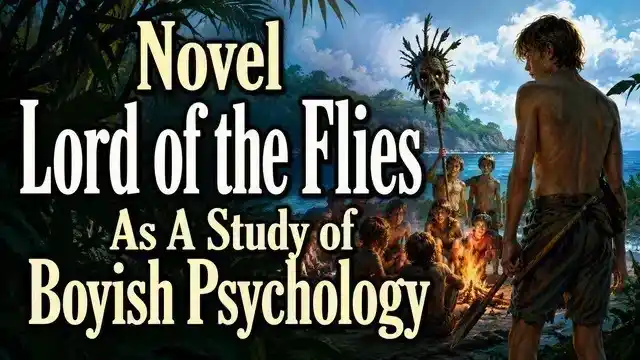
As a study of boyish psychology, Lord of the Flies offers an extraordinary insight into the emotional, intellectual, and behavioural patterns of children. Golding portrays the boys as ordinary schoolchildren whose personalities undergo remarkable psychological transformations in response to freedom, isolation, fear, and the absence of authority. Their gradual descent from disciplined and civilized individuals into violent and savage beings reveals the fragile nature of human morality. The novel suggests that the potential for evil is not acquired from society alone but exists within every individual from birth. The island becomes a psychological laboratory where the boys’ instincts, desires, fears, ambitions, and inner conflicts are exposed with startling realism.
Golding further demonstrates that each major character represents a distinct aspect of human psychology. Ralph symbolizes reason, responsibility, and civilized leadership; Jack embodies the instinct for power, violence, and domination; Piggy represents intelligence, logic, and scientific thinking; Simon personifies spiritual insight, compassion, and moral goodness; while Roger illustrates the terrifying growth of cruelty when social restraints disappear. Together, these characters reveal the complex dimensions of the human mind and the psychological forces that shape individual behaviour.
The novel also explores important psychological themes such as fear of the unknown, group mentality, mob psychology, loss of innocence, the conflict between civilization and savagery, and the influence of authority and power. Golding masterfully shows how fear can distort judgment, how the desire for acceptance can lead individuals to commit acts of violence, and how the excitement of collective action can suppress conscience and morality. The imaginary “beast” becomes a symbol of the inner darkness that resides within every human being, reinforcing Golding’s belief that the real enemy is not external but lies within the human psyche itself.
Thus, Lord of the Flies is much more than a survival novel; it is a penetrating psychological study of childhood and human behaviour. By examining the thoughts, emotions, instincts, and actions of the stranded boys, Golding reveals the delicate balance between civilization and savagery and exposes the universal truths about human nature. The novel remains a timeless masterpiece because its psychological insights extend beyond childhood to reflect the strengths and weaknesses inherent in all human beings, making it an enduring work of literary, psychological, and philosophical significance.
William Golding was the son of a distinguished school master. He had become a school master himself and wrote deeply imaginative fables of human of condition of our times. This novel reveals Golding’s philosophy that good and bad can exist side by side in the darkness of a man’s heart. So, the world should restore principles in an unprincipled world.
Teaching Profession gave him Knowledge of Human Psychology:
Golding was a school master by profession. After his academic studies, he had been teaching for several years before he gave up teaching in 1962 and devoted full time to writing. These long years of contact with school children gave him a deep knowledge of boyish psychology. So in the novel, ‘The Lord of the Flies’ he dealt with a group of British children . They are cut off from the civilized world and fall into barbarism. They should have hold up human values and behaved better and hold up their traditions. Because there are no grown-ups to guide and control them in a disciplined life, they are free to manage things in the boyish way. At first they are happy because they are free and get freedom in their own way. But soon they are led astray. They develop enmity and are twined savage und Jack. Golding brings out that young minds can be easily influenced by external factors of the surroundings. So, they are easily enticed and altered by the meat of Jack. They desert Ralph who ensured them an ordered, peaceful life for them.
Psychology of different Types of Boys:
We get a selected group of boys in the novel. They are types as well as individuals. They not only represent a class but also their own individual habits. We get a glimpse of characteristics of boys in this novel. They are as follows: Ralph is the common ideal of a British boy. He is fair haired, courageous and lovable boy. He is agile, tall and athletic in body shape. He is fit to be a leader. So, he is elected leader and chief unanimously by voting. So, he is rewarded by his qualities by his final rescue.
Jack is on the other hand, is counterpart of Ralph. He is the common bully in any school. He is jealous, savage and does not obey rules. He exploits the fear among the boys for his own advantage. His face is crumpled and freckled and ugly. He is quick to anger, proud and aggressive.
Piggy, too, is a typical boy found among any group of the boys. He is a ‘begun’ but physically incapable and emotionally immature. He is fat. He becomes the butt of – ridicule. But he is an intelligent boy who has the power to think. He alone is able to think clearly and find solutions to their problems. He stands for the observance of rules and regulations. Simon is helpful but individualist. He is a dreamer. He has the power of intuition. He is a rationalist. So, he does not believe in the existence of beast. He is fearless who alone finds out the truth that it was the body a dead pilot. It was not the beast.
Sam and Eric and the Twins: They are also typical. They talk, act and smile alike. One can be distinguished from the other. They are called Samneric. Their hands are round so they are bullets. But they lack sense they lack maturity.
We have the group of ‘Littluns’. They are the boys who have no special characteristics. They live their own live. So, they are always away from the bigger boys. In this way, we have whole gallery of all types of boys. The author handles each type convincingly.
Situation, Problem and their Rescue:
The passenger tube crash-lands on an unknown land. The group of the boys has been evacuated (carried out) by an aeroplane to an unknown destination. They are cut off from the world of grown-ups. The strange situation is accepted differently by the first two boys Ralph and Jack. They are introduced first of all Piggy is frightened at the prospect of a life without elders. But Ralph is delighted because he gets freedom to get his ambition fulfilled. So, we get a correct estimate of boyish behaviour in such a situation. They are happy because they are out of the sight of their parents. The boys here organize themselves under a chief with certain rules and regulations. They discuss the matter and decide things themselves. It reminds us the life of a public school. But soon problems crop up. No one likes to keep their rules. They prefer game and hunting. They forget their serious duty. They go for hunt and neglect the fire – burning. They paint their faces like savages. They neglect building of shelters. So, they forget their values. They will run after fun and joy.
Appearance of the Beast and the Fear:
Then there is the appearance of beast. It creates fear among the boys. They begin to dream of monsters. They are frightened when they hear such stories. They blindly believe reports. They do not care to investigate the mysterious savage. At first it is reported to be snake then as a monster from the sea. A huge ape – like thing sitting with its head between its knees is seen by the bigger boys. The beast has become a reality for them. Jack exploits the situation and tries to perpetuate the fear to keep his hold on the boys. Simon does not believe in the beast. He goes alone up the mountain and finds that it was the dead body a pilot. But he is murdered before he reveals the truth. And the truth dies with his death.
Jack understands Boyish Psychology:
Golding seems to give message through this novel that a British should hold up his traditions and civilized life under tough conditions. Jack plays on boyish psychology. He understands boyish psychology and weans away the boys from Ralph’s group by enticing good meat and thrill of hunting. Jacks tribe with painted bodies and speaks with their dancing and song as a great attraction for the boys. They give up the disciplined life under Ralph. So, the boys leave their civilized life for one of barbarism and irrational dictatorship.
Conclusion:
Thus, Golding has brought up his deep knowledge of teaching profession in revealing boyish psychology. He gives a continuous picture of different types of boys, their individual characteristics, their ideals and their attractions. It is true to say that novel ‘Lord of the Flies’ is really a deep study of boyish psychology, behaviour and individuality.