Introduction of the Poem:
“Background, Casually” is one of the most significant autobiographical poems by Nissim Ezekiel, a pioneering voice in modern Indian English poetry. First published in his collection The Unfinished Man (1960), the poem presents a candid account of the poet’s personal journey from childhood to maturity. Through a series of vivid memories, Ezekiel reflects on his experiences of cultural alienation, religious identity, social prejudice, loneliness, self-discovery, and his gradual acceptance of India as his true home. Written in a conversational yet deeply reflective tone, the poem traces the emotional and intellectual development of a sensitive individual who constantly struggles to define his place in society.
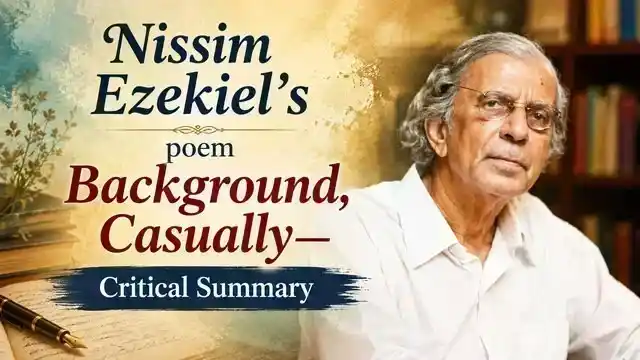
The poem is not merely a personal autobiography but also a commentary on the complexities of postcolonial Indian identity. As an Indian Jew educated in a Christian school and living among people of different religions and cultures, Ezekiel experienced a sense of isolation and displacement from an early age. His journey to England, his disappointments abroad, and his eventual return to India help him realize that identity is not determined by race, religion, or geography but by one’s commitment to one’s homeland. The concluding declaration, “My backward place is where I am,” symbolizes his acceptance of India with all its imperfections and his determination to contribute to its cultural and literary life.
Rich in autobiographical elements, irony, symbolism, and philosophical insight, “Background, Casually” explores universal themes such as identity, belonging, alienation, cultural conflict, self-realization, and commitment. The poem stands as a powerful testament to Ezekiel’s belief that true maturity comes through self-examination and acceptance. It remains one of the finest examples of modern Indian English poetry, admired for its honesty, simplicity, and profound exploration of the human search for identity.
“Background, Casually,” an autobiographical poem, was included in Hymns in Darkness (1976). Following the tradition of confessional poetry, such as Robert Lowell’s Life Studies, Ezekiel here refers to himself as “a mugging Jew among the wolves” when he was a student at a Roman Catholic school. He was shabbily and callously treated by all the boys – Christians, Muslims and Hindus. As the only Jew among them, he was looked down upon by all of them. As a result, he is bitter and sarcastic about his intolerant school fellows, particularly about the Hindus.
Critical Summary:
Endowed with talent for poetry as a child, Ezekiel had a potential for roguery and clowning. He was easily frightened as a result of which he did not eat and sleep well. He was very thin. He did not have the talent for flying a kite or spinning a top. He was so poor that he could not afford to buy any toys.
He was sent to a Roman Catholic school. He learnt his lessons by heart but he was ill – treated by his school – fellows as he was the only Jew among the Christian, Muslim and Hindu boys there. The Christians accused him of belonging to the race responsible for the crucifixion of Jesus Christ. He, however, won a prize for having studied the Christian scriptures well. The Muslim boys were so intolerant of him that they beat him up one day . This instilled in him a fear of the well-built and muscular boys. The Hindu boys were not so strong but he was repelled by their excessively passive nature. In sheer desperation, one day he used a knife against the boys who were teasing and tormenting him. parents offered the usual prayers on Friday
At home, the poet’s parents offered the usual prayers on Friday nights. They thought that their son’s behaviour was deteriorating as he was not sufficiently performing his religious duties. He heard some Hindu boys talking of yogic exercises as well as some people talking about the Jewish religion and its gospel. But he was at a loss to assess what he was fit for. For some time he wanted to become a rabbi but he could not make up his mind about leading the saintly life of a Jewish priest.
At twenty – two Ezekiel was sent abroad for higher studies even though his parents had no money to pay for his expenses. A friend agreed to pay for his passage to London, where he lodged in a basement room. He had three companions that time — philosophy, poverty and poetry.
Ezekiel didn’t do anything conspicuous during his stay in England. Nor did he have much company for the first two years. He then came into contact with a woman who made him conscious of his manhood. However, he had not made any progress in any direction. Having failed in every way, he became bitter and decided to return to India.
Again, he had no money to pay for his passage. He took up a menial job on a British cargo ship carrying French guns and other weapons of war to Indo – china. He scrubbed the ship’s decks. It was only after he had safely arrived in Bombay back with his parents that he was able to laugh once more. But he found it difficult to consider India as his real home as he had always been treated with contempt by the Hindus. Moreover, his father told him that all Hindus were alike in their behaviour, which was offensive and obnoxious. They regarded him as coming from a family of oil – pressers, which they did not consider a respectable vocation. In any case, Ezekiel now committed the folly of getting married.
One of Ezekiel’s ancestors had been a Major in the British army during the Boer War. This gave him nightmares as he started imagining himself a prisoner of the enemy forces. Subsequently, he decided to dream of becoming a wordsmith, i.e., choosing the words he should use for writing poetry. He wrote as the words came to him. This carefree and spontaneous manner of versification made him lose his grip on things. After this, he adopted a style that would universalize the inner tumults of fellow – beings and express his views on social upheavals, This helped him in “commercializing” his poetry.
Ezekiel came to view India as a place where the heat is scorching. But he became a part of his environment and the foreigners considered him an Indian even though their impression was exaggerated. He decided to stay back in India in spite of the fact that it is considered a backward country.
Critical Analysis of the Poem:
Introduction:
“Background, Casually” is one of Nissim Ezekiel’s finest autobiographical poems, first published in his celebrated collection The Unfinished Man (1960). The poem presents the poet’s life journey from childhood to maturity in a simple, conversational, and seemingly casual manner. However, beneath its relaxed tone lies a profound exploration of identity, alienation, cultural conflict, self-discovery, and artistic commitment. Through a series of autobiographical episodes, Ezekiel narrates his experiences as an Indian Jew, his struggles with religion, society, education, foreign travel, marriage, and ultimately his acceptance of India as his true homeland. The poem reflects his remarkable ability to transform personal experiences into universal human concerns.
Title: Apt and Symbolic:
The title “Background, Casually” is highly appropriate because it suggests an informal narration of the poet’s personal background. The word “casually” is ironic; although the narration appears relaxed and conversational, the events described are emotionally intense and psychologically significant. The title also reflects Ezekiel’s characteristic style of presenting serious philosophical and social issues with simplicity and understatement. Thus, the title perfectly captures both the autobiographical nature and the understated tone of the poem.
An Autobiographical Poem:
The poem is essentially an autobiographical account of Ezekiel’s life. He recounts his childhood as a timid and sensitive boy, his education in a Roman Catholic school despite being Jewish, his experiences of religious prejudice, his search for spiritual meaning, his difficult years in London, his return to India, and finally his decision to dedicate himself to his homeland and poetry. Rather than glorifying his life, he honestly records his failures, disappointments, and gradual personal growth, making the poem authentic and deeply human.
Theme of Identity and Belonging:
The central theme of the poem is the search for identity. Ezekiel belonged to the small Bene Israel Jewish community in India, which made him feel different from both Indians and Europeans. As a child, he experienced religious discrimination, while in England he felt like an outsider. Even after returning to India, he struggled to understand his place in society.
Gradually, he realizes that identity is not determined by religion, race, or nationality but by personal commitment and emotional belonging. His declaration:
“My backward place is where I am.”
reveals his mature acceptance of India as his permanent home despite its imperfections. The poem thus celebrates the idea that true belonging arises from conscious choice rather than birth alone.
Alienation and Loneliness:
Alienation runs throughout the poem. The frightened child, the isolated student, the lonely immigrant in London, and the returning Indian all experience various forms of isolation. In London, he remains alone for two years and suffers emotional and intellectual failure. His loneliness becomes a catalyst for introspection, eventually leading him toward artistic maturity. Ezekiel presents alienation not merely as suffering but also as a source of self-knowledge.
Religious and Cultural Conflict:
Religion plays a significant role in shaping the poet’s early experiences. As a Jewish student in a Roman Catholic school, he faces accusations of having “killed Christ,” highlighting the ignorance and prejudice surrounding religious identity. At home, Jewish prayers continue, while the poet becomes curious about Yoga, Zen, and other spiritual traditions.
This religious diversity reflects India’s pluralistic culture. Instead of embracing one rigid belief system, Ezekiel presents spirituality as a lifelong search rather than a fixed destination.
Search for Self and Spiritual Meaning:
Throughout the poem, the speaker continually searches for meaning and purpose. His exploration of philosophy, religion, poetry, and foreign cultures represents an inner quest for truth. However, each attempt leaves him dissatisfied:
“The more I searched, the less I found.”
This paradox reflects the existential uncertainty of modern life. True understanding finally emerges not from abstract philosophy but from accepting one’s own limitations and responsibilities.
The Journey from Failure to Self-Realization:
The poem traces the poet’s gradual transformation. Childhood fears, academic struggles, financial hardship, unsuccessful experiences abroad, and emotional disappointments initially make him feel like a failure. Yet these setbacks strengthen his personality and deepen his understanding of life.
His return to India symbolizes not defeat but renewal. Instead of escaping reality, he learns to embrace it with humility, humour, and wisdom.
Commitment to India:
One of the poem’s most significant achievements is its affirmation of Indian identity. Although Ezekiel frequently criticizes Indian habits and social behaviour, his criticism arises from affection rather than rejection. He openly acknowledges India’s shortcomings but refuses to abandon his homeland.
His concluding lines:
“This is one: to stay where I am… My backward place is where I am.”
express a conscious moral and artistic commitment to India. The poet chooses to contribute to his country’s literary and cultural life instead of seeking recognition abroad.
Theme of Poetry and Artistic Growth:
The poem also traces the evolution of Ezekiel as a poet. Personal suffering, loneliness, and disappointment gradually become sources of artistic inspiration. He realizes that words possess both creative and deceptive power:
“I did not know that words betray.”
Despite this awareness, he continues writing poetry because it enables him to understand himself and the world. The poem itself demonstrates how personal experience can be transformed into enduring literature.
Psychological Realism:
Ezekiel portrays the complexities of the human mind with remarkable honesty. He does not present himself as a heroic figure but as an ordinary individual full of fears, doubts, contradictions, and weaknesses. His emotional honesty makes the poem psychologically convincing and universally relatable.
Social Criticism:
The poem contains subtle criticism of various aspects of Indian society. Ezekiel comments on religious intolerance, cultural stereotypes, social passivity, noisy public behaviour, and narrow-minded attitudes. However, his criticism is balanced by self-criticism. Instead of blaming society alone, he examines his own prejudices and limitations, giving the poem moral depth and fairness.
Use of Irony and Humour:
Irony is one of the poem’s most striking features. Serious experiences are narrated with wit and understated humour. For example, winning the scripture prize after being accused of killing Christ is deeply ironic. Similarly, describing himself as a “poet-rascal-clown” reflects self-deprecating humour.
This ironic tone prevents the poem from becoming sentimental and allows Ezekiel to treat painful experiences with emotional balance.
Imagery and Symbolism:
Although primarily conversational, the poem contains several effective images and symbols: The frightened child symbolizes insecurity and vulnerability. Flying a kite represents confidence and freedom that the child lacks. The English cargo ship symbolizes transition and self-renewal. Storms represent both internal emotional conflicts and external social challenges. The Indian landscape symbolizes the complex reality of India that ultimately becomes inseparable from the poet’s identity. These symbols enrich the poem without disturbing its simplicity.
Language and Style:
The language is plain, direct, conversational, and highly accessible. Ezekiel deliberately avoids decorative expressions and writes in everyday English. His free verse, short sentences, and autobiographical narration create an intimate relationship between the poet and the reader.
The style is characterized by: Simplicity and clarity, Conversational tone, Controlled irony, Self-reflection, Understatement, Psychological realism, Intellectual honesty. The apparent simplicity conceals considerable emotional and philosophical depth.
Structure and Narrative Technique:
The poem follows a broadly chronological structure, tracing the poet’s life from childhood to maturity. Each stanza represents a distinct phase of experience while contributing to the larger narrative of personal development. The first-person narration creates authenticity, making the reader feel as though the poet is sharing memories directly.
Universal Significance:
Although deeply personal, the poem transcends autobiography. It speaks to anyone who has experienced loneliness, cultural conflict, uncertainty, failure, or the search for identity. The themes of belonging, self-discovery, commitment, and resilience possess universal relevance, making the poem meaningful across cultures and generations.
Conclusion:
“Background, Casually” stands as one of Nissim Ezekiel’s greatest autobiographical achievements. It combines personal history with philosophical reflection, social criticism, and artistic self-examination. Through simple language, subtle irony, and psychological honesty, Ezekiel transforms the story of his own life into a profound exploration of identity, belonging, and human growth. The poem ultimately celebrates self-acceptance, intellectual maturity, and unwavering commitment to one’s homeland, making it a landmark work in modern Indian English poetry.